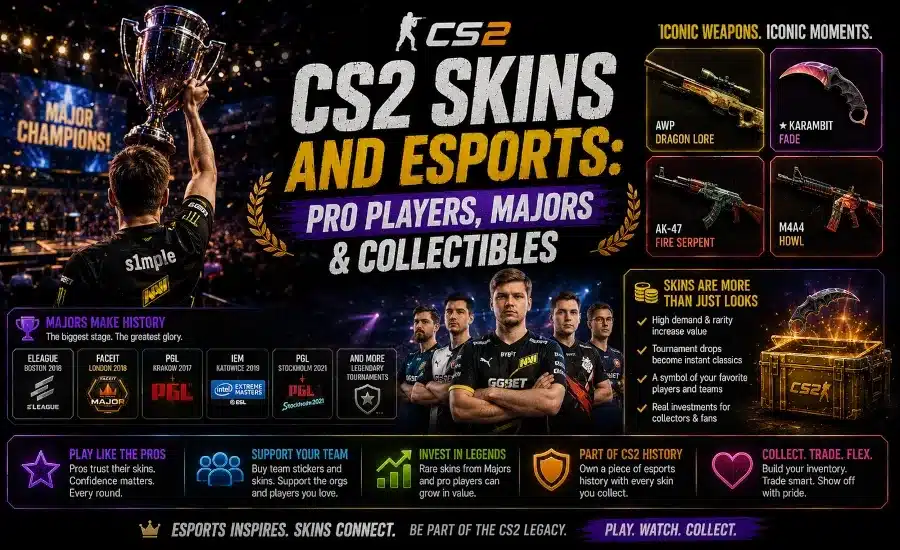
Counter-Strike 2 skins and professional esports have become deeply connected.
Every major tournament puts the inventories of the world’s best players in front of hundreds of thousands—and sometimes millions—of viewers. An AK-47, AWP, knife, or pair of gloves used by a famous professional can receive enormous exposure during a single event.
But the relationship goes much further than professional players using expensive skins.
Counter-Strike Majors have created an entire ecosystem of:
- team stickers,
- player autograph stickers,
- Souvenir Packages,
- Souvenir weapon skins,
- tournament collections,
- legendary sticker crafts,
- historically significant collectibles.
Some of the most desirable Counter-Strike items today owe much of their collector status to esports.
In this guide, we’ll explore how CS2 skins and esports influence each other, why Major tournaments matter to collectors, how professional players can affect skin popularity, and why tournament-related cosmetics have become an important part of Counter-Strike history.
Quick Answer: How Does Esports Affect CSGO Skins?
Professional Counter-Strike can influence the CS2 skin ecosystem primarily through visibility, tournament cosmetics, collector culture, and historical significance.
When popular professional players use particular skins, those items receive exposure to a global audience. Major tournaments also introduce official cosmetic items such as team and player stickers and Souvenir items.
This doesn’t mean that a professional player using a skin will automatically increase its price.
However, esports can contribute to:
- increased visibility,
- stronger community interest,
- collector demand,
- historical associations,
- popularity of particular sticker crafts.
The relationship between esports and skins is therefore both cultural and economic.
Key Takeaways
| Factor | Impact on CSGO Skins |
|---|---|
| Pro player inventories | Increase visibility of particular skins |
| Major tournaments | Generate tournament-related collectibles |
| Team stickers | Connect skins with esports organizations |
| Player autographs | Connect items with individual professionals |
| Souvenir skins | Provide tournament-linked collectibles |
| Famous matches | Can create historical associations |
| Sticker crafts | Combine skin design with esports history |
| Collector demand | Can create premiums for desirable combinations |
The Connection Between CS 2 Skins and Esports
Counter-Strike has one of the longest-running competitive scenes in esports.
Over the years, professional competition has produced legendary:
- teams,
- players,
- tournaments,
- rivalries,
- clutches,
- championship runs.
At the same time, the skin economy has grown alongside competitive Counter-Strike.
This creates an unusual relationship.
Fans don’t only watch their favorite professionals.
They can also recreate elements of their inventories.
A player watching a professional use a particular AWP might later search for the same finish.
Another fan might build an AK-47 craft featuring stickers from their favorite esports organization.
A collector may search for a Souvenir weapon connected to a particular Major.
Skins therefore give fans another way to interact with professional Counter-Strike.
Why Professional Players Matter to Skin Culture
Professional players are among the most visible Counter-Strike players in the world.
During tournaments, spectators constantly see their weapons through:
- first-person perspectives,
- observer cameras,
- highlights,
- replays,
- social media clips.
This gives professional inventories enormous exposure.
Consider an AWP player repeatedly appearing on tournament broadcasts with a distinctive weapon finish.
Every time the observer switches to that player, viewers see the skin.
Over dozens of matches, that can create considerable recognition.
Eventually, players may begin associating a particular finish or sticker craft with that professional.
Pro Players as Unintentional Skin Influencers
In fashion, celebrities can influence demand simply by wearing particular products.
Something similar can happen in Counter-Strike.
Professional players aren’t necessarily trying to promote skins.
Nevertheless, their inventories are highly visible.
Fans frequently search for:
- pro player inventories,
- pro player knives,
- pro player gloves,
- AWP skins used by professionals,
- AK-47 crafts used in tournaments.
This creates what we might call the pro player effect.
A skin receives attention because a respected player uses it.
Does a Pro Player Using a Skin Increase Its Price?
Not necessarily.
This distinction is important.
A professional player using a particular skin does not automatically cause its market price to rise.
CS2 skin prices depend on many factors, including:
- supply,
- demand,
- rarity,
- float value,
- Pattern Seed,
- collection availability,
- overall market conditions.
Professional exposure can increase awareness or interest, but it is only one potential demand factor.
For this reason, buying a skin simply because a famous player uses it should not be treated as an investment strategy.
Signature Inventories
Some professional players become associated with particular inventory styles.
This might involve:
- a distinctive knife,
- matching gloves,
- an iconic AWP,
- rare sticker crafts,
- unusual float values.
Over time, fans recognize these combinations.
The weapon becomes part of the player’s visual identity.
This is particularly powerful for AWPers because spectators frequently see the AWP during important rounds.
Why the AWP Is So Important to Skin Culture
Few weapons receive as much attention during professional Counter-Strike as the AWP.
There are several reasons.
First, professional AWPers are often star players.
Second, the AWP has a very large weapon model, giving artists considerable space for elaborate designs.
Third, spectators frequently follow AWP players because their positioning can determine how a round develops.
This has helped make skins such as the:
- AWP | Dragon Lore,
- AWP | Gungnir,
- AWP | Medusa,
- AWP | Asiimov,
some of the most recognizable weapon finishes in Counter-Strike culture.
Their value is not caused solely by esports, of course. Scarcity, collection availability, condition, and collector demand are major factors.
But professional Counter-Strike has given these skins enormous visibility, so, more buy cs2 csgo skins you will have more ingame items..
The AWP Dragon Lore and Esports Culture
Few skins illustrate the connection between collecting and esports better than the AWP | Dragon Lore.
The Dragon Lore became one of Counter-Strike’s most recognizable skins due to a combination of:
- distinctive artwork,
- desirable weapon,
- limited supply,
- Cobblestone Collection origin,
- Souvenir versions,
- professional tournament exposure.
Its association with the old Cobblestone Souvenir ecosystem added another layer of collector interest.
Certain Souvenir Dragon Lore examples became particularly notable because they combined an already rare skin with tournament-specific stickers and provenance.
This demonstrates an important principle:
the most interesting esports collectibles often combine skin rarity with tournament history.
Major Championships Changed CS Skin Collecting
Valve-sponsored Counter-Strike Majors are among the most important events in competitive Counter-Strike.
For skin collectors, however, Majors represent more than tournaments.
They have historically introduced official digital memorabilia connected to participating:
- teams,
- players,
- events.
This created a new category of Counter-Strike collectible.
Instead of owning only a visually appealing skin, players could own cosmetic items connected to specific moments in esports history.
Major Stickers
Tournament stickers have become one of the most important connections between esports and the CS2 economy.
Major-related sticker releases can feature:
- team logos,
- player autographs,
- tournament branding,
- different visual finishes.
Players can apply these stickers to their weapons and create personalized crafts.
The result is a hybrid collectible:
weapon skin + esports memorabilia
Why Team Stickers Are Popular
Counter-Strike fans often have strong connections to their favorite organizations.
Applying a team sticker to a weapon allows them to represent that organization inside the game.
A fan might build an inventory around:
- one team,
- a particular Major,
- a championship roster,
- a favorite era of Counter-Strike.
For most players, this is simply personalization.
For collectors, however, older and scarcer stickers can become highly desirable.
Katowice 2014 Changed Sticker Collecting
No discussion of Counter-Strike esports cosmetics would be complete without mentioning Katowice 2014.
Stickers from this tournament have become some of the most famous collectibles in Counter-Strike.
Certain examples are exceptionally scarce and highly sought after.
Their status developed from a combination of:
- age,
- limited surviving supply,
- recognizable designs,
- historic teams,
- collector demand,
- significance within early CS:GO esports.
Today, Katowice 2014 sticker crafts represent a specialized segment of high-end Counter-Strike collecting.
Why Old Stickers Can Become So Valuable
Unlike a weapon skin, applying a sticker historically changes how that individual sticker item exists within the economy.
As stickers are applied over time, the number remaining as standalone tradable items can decline.
That creates an interesting supply dynamic.
If demand for a historic sticker remains strong while unused supply decreases, scarcity can become increasingly important.
This is one reason older tournament stickers can attract collector premiums.
Sticker Crafts Create Unique Weapons
Once a sticker is applied to a weapon, the combination can create a highly individualized item.
Collectors evaluate crafts based on factors such as:
- base skin,
- sticker type,
- number of stickers,
- placement,
- visual compatibility,
- rarity,
- historical significance.
For example, four matching tournament stickers placed on a suitable AK-47 can create a very different collector item from the same AK-47 without stickers.
This is where esports memorabilia becomes directly integrated into weapon customization.
Player Autograph Stickers
Team stickers represent organizations.
Autograph stickers represent individual professionals.
This gives fans another way to connect with their favorite players.
Depending on the tournament and format, Major-related autograph cosmetics can create collectible links to individual careers.
A fan may choose a sticker because they admire the player.
A collector may value it because of:
- rarity,
- visual design,
- player significance,
- tournament history.
These motivations can overlap.
When a Player Becomes a Legend
Esports history changes how collectibles are perceived.
A sticker associated with a player early in their career may later gain additional cultural significance if that player becomes one of Counter-Strike’s defining stars.
Likewise, stickers associated with legendary championship rosters can become reminders of particular eras.
This doesn’t guarantee price appreciation.
But it demonstrates how history can add meaning to digital collectibles.
Souvenir Skins: Digital Esports Memorabilia
Souvenir skins are another important link between professional Counter-Strike and collecting.
They are special versions of weapon finishes associated with Major tournament souvenir systems.
Depending on the relevant tournament era and Valve’s system at the time, Souvenir items can contain tournament-related stickers or other identifying characteristics.
This makes them fundamentally different from ordinary versions of the same finish.
What Makes a Souvenir Skin Special?
A normal weapon skin primarily represents:
design + rarity + condition + pattern
A Souvenir skin can add:
tournament context
This additional layer gives collectors another reason to differentiate individual items.
A Souvenir weapon can potentially be interesting because of:
- tournament,
- teams,
- map or collection,
- stickers,
- weapon finish,
- float,
- historical context.
The exact characteristics depend on the tournament and the souvenir system used at the time.
Not Every Souvenir Skin Is Expensive
The word Souvenir doesn’t automatically mean valuable.
Many Souvenir skins are relatively affordable.
Their market value still depends on normal economic factors such as:
- supply,
- demand,
- skin rarity,
- weapon popularity,
- condition,
- stickers,
- collector interest.
A common Souvenir item from a heavily supplied tournament may be inexpensive.
A rare combination from an older event can be a completely different story.
Esports Adds Provenance to CSGO Skins
One of the most interesting concepts in collecting is provenance.
In traditional collectibles, provenance describes the history or origin of an item.
For example:
- Who owned it?
- Where did it come from?
- Was it connected to an important event?
Counter-Strike’s tournament cosmetics can create a digital version of this concept.
A collectible may be associated with:
- a specific Major,
- specific teams,
- a particular player,
- a historic era.
That story can matter to collectors.
Digital Collectibles With a Story
Imagine two visually similar weapons.
One is simply an attractive skin.
The other is connected to an old Major, carries historically significant stickers, and represents an era that longtime Counter-Strike fans remember.
Technically, both are digital items.
Emotionally, however, collectors may view them very differently.
This is one of the reasons esports has become such an important part of CS2 collecting.
Skin Design and Esports Visibility
Artists designing Counter-Strike skins cannot control whether professional players will eventually use their work.
However, skins that are highly recognizable during broadcasts have an advantage in terms of visibility.
Features that help include:
- strong colors,
- distinctive silhouettes,
- recognizable artwork,
- clear contrast.
This connects directly with what we discussed in How CSGO Skins Are Designed.
A design that remains recognizable during fast gameplay may also remain recognizable during tournament broadcasts.
From Artist to Major Stage
The lifecycle of a community-created skin can therefore become surprisingly long:
Artist Concept → Steam Workshop → Valve Selection → Official Release → Player Inventory → Professional Player → Major Broadcast → Global Audience
An artist can create a weapon finish without knowing where it will eventually appear.
Years later, that same design might be visible during one of the biggest matches in Counter-Strike history.
That’s an extraordinary form of community participation.
Expert Tip: Don’t Buy a Skin Only Because a Pro Uses It
Professional-player exposure can make a skin more desirable, but it doesn’t guarantee future value.
Before paying a premium, evaluate the item itself:
Supply → Collection → Float → Pattern → Stickers → Historical Sales → Collector Demand
A professional player using the same finish should be considered additional cultural context—not proof that the skin will increase in price.
How Souvenir Packages Work
Souvenir Packages are special Counter-Strike containers associated with Major Championships.
Unlike ordinary weapon cases, Souvenir Packages are tied to tournament content and contain Souvenir versions of weapon skins from the relevant collections.
The exact mechanics have changed over the history of Counter-Strike.
That distinction matters.
Older Souvenir systems shouldn’t automatically be described as working exactly like current ones.
Valve has modified how players acquire tournament-related items over time, while the broader idea remains the same:
Major → Souvenir Package → Tournament-related weapon collectible
Souvenir Packages vs Regular Weapon Cases
Although both can contain weapon finishes, they serve different purposes.
| Feature | Souvenir Package | Regular Weapon Case |
|---|---|---|
| Connected to esports | Yes | Usually no |
| Major-related | Yes | No |
| Contains weapon skins | Yes | Yes |
| Souvenir variants | Yes | No |
| Tournament context | Yes | No |
| Standard case key model | No | Typically case-specific opening system |
| Collector significance | Often | Depends on item |
For collectors interested specifically in Counter-Strike esports history, Souvenir items can therefore provide something normal case skins cannot.
Why Major Collections Matter
The collection associated with a Souvenir Package can dramatically affect the desirability of its possible contents.
Certain map collections have become famous because they contain extremely desirable weapon finishes.
Historically important examples include collections associated with maps such as:
- Cobblestone,
- Mirage,
- Dust II,
- Inferno,
- Overpass,
- Ancient,
- Vertigo.
However, collections can change over time.
Valve can introduce updated versions or modify which collections are associated with tournament maps.
Collectors therefore need to identify the specific collection and tournament era, rather than relying only on the map name.
The Cobblestone Collection
Few collections illustrate the relationship between skins and esports better than the Cobblestone Collection.
Its most famous item is:
AWP | Dragon Lore
The Dragon Lore was already an exceptionally desirable skin.
Its association with historic Cobblestone Souvenir Packages created an additional collector category: Souvenir Dragon Lores.
These items combine several desirable characteristics:
- iconic weapon,
- famous skin,
- scarce collection,
- Souvenir status,
- tournament-related stickers,
- potential historical significance.
This combination helped create some of the most recognizable high-end collectibles in Counter-Strike.
Why Souvenir Dragon Lores Became Legendary
A Souvenir Dragon Lore isn’t valuable simply because the word “Souvenir” appears in its name.
Several layers of scarcity and demand overlap.
Think of the hierarchy like this:
AWP
↓
Dragon Lore
↓
Rare Cobblestone Collection item
↓
Souvenir version
↓
Specific Major
↓
Sticker combination
↓
Float Value
↓
Collector demand
Each additional characteristic can make an individual item more interesting to specialized collectors.
This demonstrates an important principle of the CS2 economy:
The rarest collectibles often derive their value from several overlapping characteristics rather than one single feature.
The Evolution of Souvenir Stickers
Souvenir skins have also changed visually across different eras of Counter-Strike.
Older tournament items may have sticker configurations and characteristics that differ from newer Souvenir systems.
This makes the tournament year important.
Two Souvenir skins with the same base weapon finish can have different collector appeal depending on when and how they entered the ecosystem.
Collectors therefore often evaluate:
- Major event,
- participating teams,
- sticker design,
- sticker placement,
- skin condition,
- collection,
- weapon.
Why Tournament Era Matters
Counter-Strike esports has existed for a long time.
As a result, collectors often divide tournament cosmetics into historical eras.
Early CS:GO Majors carry a different cultural significance from modern CS2 tournaments.
Older items may benefit from:
- lower surviving supply,
- historic organizations,
- discontinued sticker designs,
- nostalgia,
- early Counter-Strike provenance.
Newer items may offer more sophisticated visual designs but significantly larger supply.
Neither is automatically “better.”
They appeal to different collector segments.
Katowice 2014: The Legendary Sticker Era
If one tournament became synonymous with high-end Counter-Strike sticker collecting, it is EMS One Katowice 2014.
The tournament produced stickers that later became among the most recognizable and desirable cosmetics in Counter-Strike.
Examples associated with legendary collecting include teams such as:
- Titan,
- iBUYPOWER,
- Team Dignitas,
- Reason Gaming,
- Vox Eminor,
- Natus Vincere,
- Virtus.pro,
- Ninjas in Pyjamas.
Some holographic versions became particularly famous.
Why Katowice 2014 Stickers Became So Valuable
Several forces combined.
Limited Historical Supply
The stickers originated during a much earlier stage of the Counter-Strike skin economy.
The player base and collector culture were different from today.
Stickers Were Consumed
When players applied stickers to weapons, those stickers stopped existing as separate unused items.
Over many years, this reduced the pool of unapplied examples.
Counter-Strike Grew
As Counter-Strike’s player base and skin collecting culture expanded, more collectors became interested in historic items.
Demand grew while old supply remained constrained.
Iconic Designs
Many collectors also consider Katowice 2014 stickers visually distinctive.
Large team logos and clean designs make them attractive for high-end crafts.
Historical Significance
The tournament represents an important era in Counter-Strike esports history.
For collectors, this gives the stickers meaning beyond their appearance.
Sticker Supply Is Different From Skin Supply
Understanding sticker economics requires recognizing an important distinction.
A weapon skin can continue circulating between players.
An unapplied sticker can also circulate.
But once that sticker is applied to a weapon, the market has effectively lost one unapplied example.
That creates a form of supply consumption.
Suppose there were hypothetically 10,000 unused stickers.
If 2,000 were applied to weapons, only around 8,000 unused examples would remain, ignoring other inventory changes.
Over many years, this can create increasing scarcity.
Applied Stickers Still Have Value
Applying a rare sticker doesn’t mean all of its economic significance disappears.
Instead, its value becomes partially attached to the weapon.
Collectors call these combinations sticker crafts.
A craft can involve:
- one rare sticker,
- several matching stickers,
- four identical stickers,
- themed combinations,
- historically meaningful combinations.
However, an important rule applies:
The market value of an applied sticker is generally not equal to the full value of an unused sticker.
Sticker Percentage and Applied Sticker Value
When collectors evaluate a weapon with expensive stickers, they sometimes discuss the percentage of the sticker’s standalone value reflected in the final weapon price.
There is no universal formula.
The premium depends on:
- base skin,
- sticker rarity,
- placement,
- number of stickers,
- visual compatibility,
- collector demand,
- whether the craft is unique or replicated.
For example, putting a very expensive sticker on an unattractive or highly common weapon doesn’t automatically add the sticker’s entire standalone value to the skin.
The combination itself must attract buyers.
Sticker Placement Matters
Sticker positioning can have a major influence on collector appeal.
Certain weapon positions are more visible than others during gameplay.
Collectors may therefore pay more attention to what is commonly called the best position for a particular weapon.
This is especially relevant for:
- AK-47,
- AWP,
- M4A1-S,
- M4A4,
- Desert Eagle.
An iconic sticker placed prominently can make a craft more visually desirable.
Four-Sticker Crafts
One of the most recognizable styles of high-end customization is the 4x craft.
This involves using four matching stickers on a compatible weapon.
Examples include:
4x team sticker
or
4x holographic sticker
The objective is usually to create a consistent visual theme.
These crafts can be particularly attractive when the sticker colors complement the weapon finish.
Color Matching
Some of the most popular crafts aren’t based solely on sticker rarity.
They’re popular because they look good.
Collectors may combine:
Blue Skins
with blue or cyan esports stickers.
Red Skins
with red team logos.
Gold or Yellow Skins
with gold tournament stickers.
Black-and-White Skins
with monochrome team branding.
This transforms sticker collecting into another form of skin design.
The original artist creates the weapon.
The player creates the final craft.
Crafting vs Collecting Unapplied Stickers
Collectors generally have two broad options.
Keep the Sticker Unapplied
Advantages:
- easier to trade,
- independent market price,
- preserves flexibility,
- can be applied later.
Apply the Sticker
Advantages:
- creates a personalized weapon,
- can produce a unique craft,
- provides visual enjoyment in-game.
But application is a significant decision because it changes the sticker from a standalone collectible into part of a specific weapon.
For expensive historical stickers, collectors usually consider this very carefully.
Scraping Stickers
Counter-Strike also allows stickers to be scraped, changing their appearance.
Repeated scraping can eventually remove a sticker.
This creates another characteristic collectors may need to inspect.
A rare sticker that has been heavily scraped may have different appeal from one in its original applied appearance.
For expensive crafts, checking sticker condition is therefore important.
Player Autographs as Collectibles
Autograph stickers introduced another dimension to esports collecting.
Instead of representing only a team, players could build weapons around individual professional players.
This allows fans to create inventories connected to:
- favorite AWPers,
- riflers,
- Major winners,
- legendary players,
- specific tournament runs.
Some collectors build entire weapons featuring multiple autograph stickers from the same player.
Others recreate tournament lineups.
Building a Championship Roster Craft
Imagine a team wins a Major.
A fan could potentially create a weapon using stickers representing members of that championship roster, depending on the stickers available for the event.
The resulting weapon becomes a type of digital tribute.
It may not necessarily be extremely valuable.
But its emotional and historical meaning can make it important to the owner.
This highlights something market prices cannot fully measure:
collector value isn’t always financial value.
Famous Players and Skin Demand
Professional players can influence what ordinary players want to own.
If a famous AWPer consistently uses a recognizable skin, fans may search for:
“[player] AWP skin”
If a star rifler uses a distinctive AK-47 craft, screenshots may spread through:
- Reddit,
- X,
- YouTube,
- TikTok,
- community forums.
This can increase visibility.
But again, visibility should not be confused with guaranteed price appreciation.
The “Pro Player Premium”
For most ordinary skins, there is no formal market premium simply because a professional player owns the same finish.
However, individual items with documented connections to famous players can sometimes attract collector attention.
This is more similar to traditional provenance.
The distinction is:
Same skin model used by a pro ≠ historically owned individual item
Those are completely different collector claims.
Ownership History
For extremely expensive CS2 items, ownership history can become part of the item’s identity.
Collectors may know that a particular:
- Blue Gem,
- rare sticker craft,
- exceptional float skin,
previously belonged to a notable trader, collector, or professional player.
This history can add cultural interest.
However, provenance claims should always be verified rather than accepted solely because a seller says an item was “owned by a pro.”
Esports Organizations and Sticker Economics
Tournament stickers also create an economic relationship between Counter-Strike esports and cosmetic sales.
Official tournament items can help connect fans financially with the competitive ecosystem under Valve’s applicable tournament arrangements.
This makes cosmetics more than decorative items.
They form part of the commercial infrastructure surrounding professional Counter-Strike.
For fans, buying tournament cosmetics can combine:
support + customization + collecting
Major Sticker Sales
Major sticker capsules can attract enormous attention from players and collectors.
One reason is that tournament-related capsules may later be discounted during their sales cycle before eventually leaving the active store offering.
This has historically encouraged players to purchase large quantities.
That creates an important lesson for collectors:
Newer does not necessarily mean rarer.
Modern tournament sticker supply can be enormous.
Older stickers may have dramatically lower supply because the Counter-Strike ecosystem was much smaller when they were released.
Supply Is Critical
Consider two attractive esports stickers.
Sticker A
Historic tournament, low remaining supply.
Sticker B
Modern Major, huge number purchased.
Even if Sticker B looks better, Sticker A may command a much higher collector premium because of scarcity.
This demonstrates the same principle we see throughout the CS2 economy:
Design creates desirability.
Supply determines scarcity.
Demand connects the two.
Should You Invest in Major Stickers?
Tournament stickers are sometimes treated as speculative assets by parts of the Counter-Strike community.
However, there is no guaranteed investment formula.
Potential risks include:
- extremely large supply,
- declining player demand,
- future sticker designs becoming more popular,
- changes to Valve’s systems,
- market volatility,
- liquidity problems.
Buying thousands of capsules simply because an older tournament capsule appreciated historically does not mean a modern one will follow the same path.
Why Historical Returns Can Be Misleading
The early Counter-Strike economy was very different.
Some historic stickers became extremely valuable partly because few players anticipated that they would become collectibles.
Today, millions of players understand the market.
Many deliberately stockpile new tournament items expecting future appreciation.
That changes the supply dynamics dramatically.
This is why copying old strategies doesn’t guarantee the same result.
How to Evaluate an Esports-Related CS2 Skin
When considering a tournament-related collectible, analyze it in layers.
1. Base Skin
Is the underlying weapon finish desirable?
2. Weapon
Is it frequently used?
3. Tournament
Does the event have historical significance?
4. Team or Player
Is there meaningful collector demand?
5. Stickers
Are they scarce or visually desirable?
6. Placement
Are important stickers in attractive positions?
7. Float
Does the skin have an unusual or desirable condition?
8. Pattern
Is the finish pattern-dependent?
9. Supply
How many comparable items appear to exist?
10. Liquidity
Can the item realistically be resold?
This last point is often overlooked.
Rare Doesn’t Always Mean Liquid
A unique craft may technically be extremely rare.
But if only three collectors in the world want it, finding a buyer can be difficult.
That means:
rarity ≠ liquidity
High-end CS2 collecting often involves items for which price discovery is difficult.
The listed price isn’t necessarily the price at which a transaction will occur.
Compare Markets Before Buying
Before purchasing expensive skins or sticker crafts, compare multiple sources rather than relying on a single listing.
Our main marketplace guide is:
Avoid Overpaying for “Esports History”
Marketing language can make ordinary items sound extraordinary.
A seller might describe a weapon as:
- “Major skin,”
- “pro craft,”
- “legendary tournament item,”
- “historic sticker combination.”
These phrases don’t automatically justify a premium.
Verify the actual characteristics.
Look at:
Skin + Float + Pattern + Stickers + Placement + Supply + Comparable Sales
The story should support the collectible.
It shouldn’t replace proper valuation.
Esports Collecting vs Traditional Skin Collecting
The two categories overlap but emphasize different factors.
| Traditional Skin Collector | Esports Collector |
|---|---|
| Skin rarity | Tournament history |
| Float | Team stickers |
| Pattern Seed | Player autographs |
| Collection | Major event |
| Finish appearance | Souvenir status |
| Supply | Historical context |
| Market demand | Esports significance |
The most valuable or interesting items can combine characteristics from both sides.
When Everything Comes Together
Imagine an item with:
- desirable AWP skin,
- scarce collection,
- Souvenir status,
- historic Major connection,
- desirable stickers,
- exceptional float.
Now multiple collector categories may compete for the same item.
AWP collectors want it.
Souvenir collectors want it.
Tournament collectors want it.
Float collectors may want it.
Fans of the represented teams may want it.
This overlapping demand can help explain why certain CS2 items command extraordinary premiums.
Expert Tip: Separate the Story From the Numbers
Esports history can make a CS2 skin fascinating, but don’t let the story replace market research.
Before buying an expensive Souvenir or sticker craft, ask two separate questions:
1. Why is this item historically interesting?
and
2. What evidence supports its current market value?
A great story can increase collector appeal.
It doesn’t automatically justify any asking price.
Why Pro Player Inventories Attract So Much Attention
Counter-Strike differs from many esports because weapon cosmetics are constantly visible.
A player’s inventory can include:
- weapon skins,
- knives,
- gloves,
- stickers,
- charms,
- Souvenir items,
- rare patterns,
- unusual float values.
These items appear naturally during competition.
Players don’t need to deliberately advertise them.
When an AWPer holds an angle, viewers see the AWP.
When a player rotates with a knife equipped, viewers see the knife and gloves.
When a player reloads an AK-47, the skin and stickers become particularly visible.
This creates continuous exposure.
The Broadcast Effect
Consider what happens during a major Counter-Strike tournament.
A professional player uses a distinctive AK-47.
The weapon appears during:
Live Match
↓
Replay
↓
Highlight Clip
↓
YouTube Video
↓
TikTok / X / Reddit
↓
Community Discussion
One tournament moment can therefore generate repeated exposure across several platforms.
A skin that was previously familiar mainly to collectors can suddenly be seen by a much broader audience.
Does This Actually Affect Skin Prices?
Sometimes increased exposure may contribute to higher demand.
But establishing direct causation is difficult.
Suppose a professional player begins using a particular skin and its market price rises two months later.
Was the professional responsible?
Possibly.
But other explanations might include:
- declining supply,
- overall CS2 market growth,
- collection changes,
- increased weapon popularity,
- broader collector trends,
- speculation,
- a game update.
For this reason, claims such as “this pro player made the skin increase 30%” should be treated carefully unless supported by strong market evidence.
Visibility vs Scarcity
This distinction is fundamental.
Esports Can Influence Visibility
A famous player can introduce a skin to millions of viewers.
Esports Usually Cannot Change Its Existing Supply Directly
If 100,000 examples of a skin already exist, a professional using one doesn’t suddenly make the other examples rare.
Therefore:
Visibility can influence demand.
Scarcity depends primarily on supply.
Price emerges from the interaction between the two.
Why AWP Skins Receive Exceptional Exposure
The AWP has a special place in Counter-Strike cosmetics.
Professional AWPers are often among the most recognizable players on their teams.
During broadcasts, spectators frequently follow them because one opening kill can determine an entire round.
This gives their weapon skins considerable exposure.
Famous AWP finishes include:
- AWP | Dragon Lore
- AWP | Gungnir
- AWP | Medusa
- AWP | Asiimov
- AWP | Lightning Strike
- AWP | Desert Hydra
These skins occupy very different price ranges and rarity categories, but all have developed strong recognition within the community.
The AWP Dragon Lore
The AWP | Dragon Lore is arguably one of the strongest examples of a skin becoming part of Counter-Strike culture.
Its reputation comes from several overlapping factors:
Iconic Artwork
The dragon design is immediately recognizable.
AWP Popularity
The AWP is one of Counter-Strike’s signature weapons.
Collection Scarcity
Dragon Lore belongs to the Cobblestone Collection.
Souvenir History
Souvenir versions connect the skin with professional tournament history.
Collector Recognition
Even players who don’t actively trade skins often recognize the Dragon Lore.
This combination transformed it from a weapon finish into a symbol of high-end Counter-Strike collecting.
The AWP Asiimov Shows the Other Side
Not every iconic esports skin needs extreme scarcity.
The AWP | Asiimov became highly recognizable despite occupying a completely different market position from the Dragon Lore.
Its bold:
- white,
- orange,
- black
design makes it instantly visible during gameplay.
This illustrates an important point.
Cultural popularity and market rarity are not the same thing.
A skin can become iconic because millions of players recognize it without becoming one of the rarest items in the game.
Battle-Scarred Skins Can Become Desirable
Normally, collectors associate lower wear with higher value.
Factory New is often preferred over heavily worn examples.
But Counter-Strike has many exceptions.
Certain skins develop visually distinctive appearances at high float values.
Collectors may even create nicknames for specific wear characteristics.
This demonstrates how community culture can influence demand independently of conventional condition preferences.
Pro Players and Sticker Crafts
Professional inventories aren’t limited to expensive base skins.
Sticker combinations can be equally important.
A player may use an AK-47 featuring:
- team stickers,
- autograph stickers,
- old Major stickers,
- matching holographic stickers,
- custom crafts.
Fans sometimes attempt to recreate these combinations.
This can increase attention around both the base skin and the stickers involved.
What Is a Pro Craft?
The community sometimes uses terms such as pro craft to describe a weapon associated with a professional player’s sticker setup or inventory.
But the term should be treated carefully.
It can mean different things:
Same Design
A player creates an identical combination using the same skin and stickers.
Similar Design
The craft is inspired by a professional but isn’t identical.
Actual Item
The individual weapon was genuinely owned or used by the professional.
Only the third category involves true item-level provenance.
That’s a major distinction for collectors.
Same Craft Does Not Mean Same Provenance
Imagine a professional player uses:
AK-47 + four identical holographic stickers
Another player recreates exactly the same combination.
Visually, the weapons may appear almost identical.
Historically, they’re different.
One may have actually appeared during professional competition.
The other is a recreation.
That doesn’t necessarily make either better for ordinary gameplay, but collectors interested in provenance may value the distinction.
Can You Prove a Skin Was Owned by a Professional?
This can become difficult.
For high-value transactions, collectors may attempt to establish ownership history using available inventory records, screenshots, trade history evidence, archived content, or other verifiable documentation.
However, claims should be treated cautiously.
A marketplace description saying:
“Used by famous pro”
isn’t sufficient evidence by itself.
For expensive collector items, provenance should be documented rather than assumed.
Knives and Professional Players
Knives receive enormous exposure during professional matches.
Players frequently switch to their knives while:
- rotating,
- moving quickly,
- saving weapons,
- repositioning.
This means viewers repeatedly see knife finishes throughout a tournament.
Popular categories include:
- Karambit,
- Butterfly Knife,
- M9 Bayonet,
- Bayonet,
- Talon Knife,
- Skeleton Knife.
Specific finishes can become strongly associated with certain inventory styles.
Why Butterfly Knives Are So Visible
The Butterfly Knife is particularly noticeable because of its distinctive animations.
Players may repeatedly inspect or switch to the knife, making it highly visible during broadcasts and streams.
Its combination of:
- animations,
- premium appearance,
- desirable finishes,
- collector demand
has made it one of the most recognizable knife categories in Counter-Strike.
We’ll cover pricing more deeply in our upcoming dedicated guide:
Cheapest Butterfly Knife in CS2
which forms another part of the /cs2-skins/ content cluster.
Knife and Glove Combos
Professional players also help popularize complete cosmetic combinations.
Rather than evaluating a knife independently, many players build:
Knife + Gloves + Weapon Loadout
around a particular color theme.
Examples might include:
Blue Loadout
Blue-toned knife + complementary gloves + blue weapon skins.
Red Loadout
Red knife finish + red gloves + matching rifles.
Black Loadout
Dark knife + minimalist gloves + black weapon finishes.
The objective isn’t necessarily to own the most expensive inventory.
It’s to create visual consistency.
Why Pro Inventories Inspire Regular Players
Most players aren’t going to purchase an ultra-rare Blue Gem or top-tier Souvenir collectible.
But professional inventories can still provide inspiration.
A viewer might see an expensive combination and create an affordable alternative using:
- cheaper knife finish,
- similar color gloves,
- budget rifle skins,
- inexpensive matching stickers.
This makes esports an important source of inventory design inspiration, not simply high-end collecting.
Major Finals Create Iconic Visual Moments
Some Counter-Strike moments remain famous for years.
A legendary:
- clutch,
- ace,
- no-scope,
- comeback,
- championship-winning kill
can be replayed millions of times.
The weapon visible during that moment becomes part of the visual record.
Again, this doesn’t automatically increase its market value.
But it can create a cultural association between:
player + weapon + skin + moment
That association is particularly interesting for collectors.
Digital Memorabilia and Traditional Sports
Traditional sports fans collect:
- signed shirts,
- match-worn jerseys,
- trading cards,
- championship memorabilia.
Counter-Strike offers a digital parallel.
Fans can collect:
- Major stickers,
- player autographs,
- Souvenir skins,
- tournament capsules,
- historically significant crafts.
The comparison isn’t perfect, but the psychological motivations can be similar.
Collectors want an object connected to something they remember.
Why Major Winners Matter
Winning a Major can permanently change how a team or player’s career is remembered.
That can also change the cultural context surrounding their tournament cosmetics.
A sticker from a championship roster isn’t simply a logo.
Years later, it may represent:
- a championship,
- a legendary lineup,
- a famous upset,
- the peak of a player’s career.
This historical layer develops over time.
It cannot always be predicted when the sticker is initially released.
The Retirement Effect
A similar phenomenon can occur when a famous player retires.
Collectors may revisit:
- old autographs,
- tournament stickers,
- signature crafts,
- skins associated with that player’s career.
This can generate renewed attention.
But once again:
renewed attention ≠ guaranteed price increase.
The actual market effect depends on supply and demand.
Team Disbandments and Rebrands
Esports organizations change constantly.
Teams can:
- disband,
- leave Counter-Strike,
- change logos,
- merge,
- rebrand.
Older stickers may therefore preserve visual identities that no longer exist in the same form.
This can make them interesting historical collectibles.
For longtime fans, an old team logo can represent an entire era of professional Counter-Strike.
Roster Changes Can Also Matter
Professional rosters change frequently.
This means tournament sticker sets can effectively capture a specific lineup at a specific moment.
Collectors may build crafts representing:
- Major-winning rosters,
- legendary national lineups,
- favorite five-player teams.
This is another way esports history becomes embedded into cosmetic items.
Social Media Amplifies Everything
Professional tournaments no longer exist only on live broadcasts.
A memorable skin can appear almost instantly across:
- YouTube,
- Twitch clips,
- Reddit,
- X,
- TikTok,
- Discord.
Content creators then produce:
- inventory reviews,
- skin rankings,
- price analysis,
- “what skin does this pro use?” videos.
This creates a feedback loop.
Tournament Exposure
↓
Social Media
↓
Community Interest
↓
Marketplace Searches
↓
More Content
↓
More Visibility
The process can dramatically increase awareness of an item.
Streamers Extend Skin Exposure Beyond Tournaments
Professional players also stream outside competition.
During streams, viewers may see the same inventory for hundreds of hours.
This creates even more sustained exposure than a tournament.
Fans can also directly ask:
- What knife is that?
- What float is your skin?
- Which stickers are those?
- How much is that inventory worth?
This interaction helps spread knowledge about the skin market.
Inventory Showcases Became Entertainment
CS2 inventories have become content themselves.
Popular video formats include:
- pro inventory reviews,
- most expensive inventories,
- best knife/glove combinations,
- rarest sticker crafts,
- Blue Gem showcases.
This shows how far Counter-Strike customization has evolved.
Skins are no longer merely cosmetic objects used inside matches.
They’re also entertainment content outside the game.
High-End Collectors and Esports
The relationship between professional Counter-Strike and high-end collecting can sometimes overlap.
Collectors may own items worth substantially more than typical professional inventories.
Professional players may also borrow, trade, buy, or use high-value items.
This creates additional visibility for extremely rare collectibles.
However, viewers should not assume that every expensive skin seen on a professional player’s account necessarily represents a permanent personal purchase.
Ownership and usage are different concepts.
Why This Matters When Researching Skins
Suppose you see a professional using a $50,000 collectible.
Before writing:
“Player X owns this $50,000 skin.”
you need evidence of ownership.
A more accurate statement might be:
“Player X was seen using the skin during competition.”
This distinction improves factual accuracy and EEAT.
It is especially important for FlashyFlashy articles discussing high-value inventories.
Esports and Blue Gems
Case Hardened Blue Gems are among the collector items most likely to attract attention when they appear in professional play.
Their distinctive blue surfaces make them easy to recognize.
But individual Blue Gems can vary dramatically.
Two Case Hardened knives of the same model can have completely different collector values depending on:
- Pattern Seed,
- blue coverage,
- play-side appearance,
- float,
- condition.
Our dedicated guide explains this system:
Pattern IDs Matter More Than the Pro Using Them
This is an important valuation principle.
Imagine a professional player uses a Case Hardened knife.
A fan decides to buy the same knife model and finish.
But the fan purchases a completely different Pattern Seed.
The two items may look dramatically different.
For pattern-dependent skins, always identify the actual pattern rather than assuming every example has the same collector value.
Esports and Rare CSGO Skins
Professional exposure is particularly powerful when the item is already rare.
Consider the difference:
Common Skin + Pro Exposure
High visibility but abundant supply.
Rare Skin + Pro Exposure
High visibility combined with constrained supply.
The second situation can generate much stronger collector interest because increased demand cannot easily be satisfied by new listings.
This is why scarcity remains fundamental.
You can learn more in our Rare CSGO Skins guide.
How Professional Exposure Fits Into Skin Valuation
A simplified valuation model might look like this:
| Factor | Typical Importance |
|---|---|
| Supply | Very High |
| Skin/Collection Rarity | Very High |
| Pattern | Very High for relevant skins |
| Float | High |
| Stickers | High for crafts |
| Weapon Popularity | High |
| General Demand | Very High |
| Esports Exposure | Variable |
| Pro Ownership/Provenance | Niche but potentially significant |
Notice that esports exposure isn’t at the top.
It can strengthen demand, but it doesn’t replace the fundamentals.
Never Pay a Premium Based Only on Hype
This becomes especially important during major tournaments.
A skin can suddenly become popular on:
- Reddit,
- X,
- Twitch,
- YouTube.
Marketplace sellers may respond by increasing asking prices.
That doesn’t necessarily mean actual completed sales support those valuations.
Before buying, compare:
- recent sales,
- multiple marketplaces,
- available supply,
- historical pricing,
- similar floats,
- similar patterns.
Esports Does More Than Influence Prices
Focusing only on price misses the most important part of the relationship.
Esports gives skins cultural meaning.
A particular weapon can remind a fan of:
- a favorite player,
- a championship,
- a legendary roster,
- a Major attended in person,
- an unforgettable final.
That emotional connection is difficult to quantify.
But it is one of the reasons digital cosmetics can remain desirable for many years.
From Cosmetic Item to Counter-Strike History
This is ultimately what separates certain esports-related collectibles from ordinary skins.
They become part of the history surrounding the game.
A sticker from an old tournament isn’t simply a graphic.
A Souvenir skin isn’t simply a different version of a weapon finish.
A documented item used by a famous professional isn’t simply another Pattern Seed.
Context adds meaning.
And for collectors, meaning can be just as important as rarity.
Expert Tip: Use a Three-Layer Valuation Model
When evaluating an esports-related CS2 collectible, separate it into three layers.
Layer 1 — The Skin
Evaluate:
Weapon + Finish + Float + Pattern + Collection
Layer 2 — The Esports Elements
Evaluate:
Major + Team + Player + Stickers + Placement + Souvenir Status
Layer 3 — Market Evidence
Evaluate:
Supply + Recent Sales + Comparable Listings + Liquidity + Demand
Only after considering all three layers should you decide whether an asking price makes sense.
This approach prevents the word “historic” or “pro-owned” from overshadowing the actual characteristics of the item.
Frequently Asked Questions About CSGO Skins and Esports
How do esports affect CS2 skin prices?
Esports can affect CSGO skins primarily by increasing their visibility and community interest.
When a famous professional player repeatedly uses a particular AK-47, AWP, knife, or sticker craft during major tournaments, large numbers of viewers may become interested in the same item.
However, professional exposure doesn’t automatically increase prices.
The market value of a CS2 skin still depends heavily on factors such as:
- supply,
- demand,
- rarity,
- collection,
- Float Value,
- Pattern Seed,
- stickers,
- weapon popularity.
Esports exposure should therefore be viewed as a potential demand factor rather than a guaranteed price catalyst.
Do CS2 Pro Players Influence Skin Prices?
Potentially, but the effect is difficult to measure.
A professional player can introduce a relatively unknown skin to a large audience. Streamers, YouTubers, and social media users may then amplify that exposure.
This can create increased interest.
But if the skin has enormous supply, additional demand may have limited long-term impact.
Compare that with an already scarce skin.
If a rare item suddenly receives substantial exposure, available supply may be much more limited.
A simplified model looks like this:
Pro Exposure → More Visibility → Potentially More Demand
but:
More Visibility ≠ Guaranteed Higher Price
What Are Souvenir Skins in CS2?
Souvenir skins are special versions of weapon finishes associated with Counter-Strike Major tournament souvenir systems.
They provide a direct connection between weapon cosmetics and professional Counter-Strike.
Depending on the tournament era and system used by Valve, Souvenir items can include tournament-related characteristics and stickers.
Collectors may evaluate a Souvenir according to:
Tournament + Collection + Weapon + Skin + Stickers + Float + Historical Context
This makes some Souvenir items considerably more complex to value than ordinary weapon finishes.
Are Souvenir Skins Rare?
Some are. Many aren’t.
The word Souvenir doesn’t automatically mean an item is rare or expensive.
Supply varies dramatically depending on:
- tournament,
- collection,
- weapon,
- rarity tier,
- number of packages opened.
Many modern Souvenir skins are inexpensive.
Older or particularly desirable combinations can be significantly scarcer.
Always evaluate the individual item rather than assuming all Souvenir skins have substantial value.
What Is the Rarest Souvenir Skin?
There isn’t one simple answer because rarity can be measured in different ways.
However, Souvenir AWP | Dragon Lore examples are among the most famous high-end Souvenir collectibles in Counter-Strike history.
Their desirability comes from several overlapping characteristics:
- Dragon Lore itself is iconic,
- it belongs to the Cobblestone Collection,
- Souvenir versions are historically significant,
- individual examples can have desirable tournament stickers,
- float condition can further differentiate them.
Individual examples can therefore be dramatically different in collector appeal.
Why Are Katowice 2014 Stickers So Expensive?
Katowice 2014 stickers have become legendary within Counter-Strike collecting because several important factors overlap.
They are:
- old,
- historically significant,
- associated with memorable esports organizations,
- limited in surviving supply,
- widely recognized by collectors.
Many stickers were also applied to weapons over the years, reducing the pool of unapplied examples.
Demand for desirable Katowice 2014 stickers eventually grew far beyond what players likely anticipated when they originally entered the game.
What Are the Most Famous Katowice 2014 Stickers?
Several Katowice 2014 team stickers have become famous among collectors.
Examples associated with the high-end craft market include organizations such as:
- Titan,
- iBUYPOWER,
- Reason Gaming,
- Team Dignitas,
- Vox Eminor,
- Natus Vincere,
- Virtus.pro.
Different versions and finishes can have dramatically different market values.
Collectors should therefore identify the exact sticker rather than relying only on the team name.
Does Applying an Expensive Sticker Add Its Full Value to a Skin?
Usually not.
This is one of the most important concepts for new collectors to understand.
Suppose an unused sticker has a high standalone market value.
Applying it to a weapon doesn’t normally mean:
Skin Price + Full Sticker Price = Final Weapon Price
Instead, collectors evaluate the craft itself.
Factors include:
- sticker placement,
- base skin,
- visual compatibility,
- number of matching stickers,
- rarity of the combination,
- collector demand.
Applied sticker premiums can therefore vary significantly.
What Is a 4x Sticker Craft?
A 4x craft generally refers to a weapon customized with four copies of the same sticker.
For example:
AK-47 + 4 matching holographic stickers
These crafts can create a strong visual theme, particularly when the sticker colors complement the base skin.
High-end 4x crafts using rare historical stickers can become specialized collector items.
But four expensive stickers don’t automatically make a good craft.
Appearance and buyer demand still matter.
Do Sticker Positions Matter?
Yes.
Different sticker positions can have different visibility depending on the weapon.
Collectors may prefer a valuable sticker in a particularly prominent position.
This can influence how attractive the overall craft is.
For expensive historical stickers, placement can therefore become an important part of valuation.
What Are CS2 Player Autograph Stickers?
Player autograph stickers are tournament-related cosmetics associated with individual professional players.
They allow fans to personalize weapons around favorite competitors.
Collectors may also use them to create:
- player-themed inventories,
- championship roster crafts,
- Major-related weapons,
- career tribute crafts.
Their desirability can depend on the player, tournament, design, rarity, supply, and broader collector demand.
Can a Player’s Retirement Increase Sticker Prices?
It can generate renewed interest, but a price increase isn’t guaranteed.
When a famous player retires, fans may revisit cosmetics associated with that player’s career.
This can increase:
- searches,
- social media discussion,
- marketplace activity.
However, long-term prices still depend on supply and demand.
Retirement alone isn’t a reliable investment signal.
What Happens to Stickers When an Esports Team Disbands?
Existing stickers generally remain part of the Counter-Strike item ecosystem according to the applicable item rules.
If an organization leaves Counter-Strike or changes its branding, older stickers can become visual reminders of its previous identity.
This can increase their historical appeal.
But again:
discontinued team ≠ automatically valuable sticker
Supply and collector demand remain crucial.
What CSGO Skins Are Popular With Pro Players?
Professional inventories change frequently, so there isn’t a permanent list.
However, highly recognizable weapon finishes often seen throughout Counter-Strike culture include skins such as:
- AWP | Dragon Lore,
- AWP | Asiimov,
- AWP | Gungnir,
- AK-47 | Fire Serpent,
- AK-47 | Case Hardened,
- M4A4 | Howl.
Professional players also use many inexpensive skins.
Their choices can depend on personal preference rather than price.
What Knives Do CS2 Pro Players Use?
There is no single dominant choice.
Professional players can use many knife models, including:
- Butterfly Knife,
- Karambit,
- M9 Bayonet,
- Bayonet,
- Talon Knife,
- Skeleton Knife.
Their inventories can also change over time.
For collectors, the exact:
Knife Model + Finish + Pattern + Float
matters much more than simply knowing that a professional has used the same knife model.
Does a Pro Player Owning a Skin Make It More Valuable?
Potentially—but only in specialized circumstances.
If the specific individual item has verifiable ownership history involving a famous professional player, some collectors may value that provenance.
However:
same skin used by a professional ≠ pro-owned skin
Thousands of players may own the same weapon finish.
True provenance relates to the history of the specific item.
How Can You Verify a Pro-Owned CS2 Skin?
Be cautious.
For an expensive collectible, evidence may involve a combination of:
- historical inventory records,
- archived screenshots,
- videos,
- trade documentation,
- reliable community records.
A seller simply claiming that an item was previously owned by a famous professional isn’t enough evidence to justify a large premium.
What Makes an Esports CS2 Skin Valuable?
A useful framework is:
| Factor | What to Check |
|---|---|
| Base Skin | Is the finish desirable? |
| Weapon | Is the weapon popular? |
| Collection | Is supply limited? |
| Float | Is the condition unusual? |
| Pattern | Is it a valuable Pattern Seed? |
| Tournament | Is the Major historically significant? |
| Team | Is there collector demand? |
| Player | Is the autograph desirable? |
| Stickers | Are they scarce? |
| Placement | Are important stickers well positioned? |
| Provenance | Is the history verifiable? |
| Liquidity | Are comparable items actually selling? |
The strongest collectibles often combine several of these factors.
CS2 Esports Collector Checklist
Before purchasing an expensive esports-related item, work through this checklist.
1. Identify the Exact Item
Don’t stop at:
AWP Dragon Lore
Check:
AWP Dragon Lore + Exterior + Float + Souvenir Status + Stickers
2. Check the Float Value
Two examples of the same skin can have significantly different collector appeal depending on float.
Extremely low or unusual float values can attract specialized buyers.
3. Check the Pattern Seed
This is essential for pattern-dependent finishes.
A Case Hardened item, for example, cannot be properly evaluated based only on its weapon and exterior.
Pattern placement can dramatically change its appearance and collector demand.
Read:
4. Identify Every Sticker
Don’t simply note that a weapon has “Major stickers.”
Determine:
- exact tournament,
- team or player,
- sticker finish,
- placement,
- condition.
These details can dramatically change the craft.
5. Check Tournament History
Ask whether the tournament has meaningful historical significance.
Older doesn’t automatically mean valuable, but certain events have much stronger collector communities than others.
6. Verify Provenance Claims
If the seller claims:
“This skin belonged to a professional player”
ask for evidence.
Don’t pay a major premium based purely on a description.
7. Compare Multiple Listings
Never determine market value from one seller’s asking price.
An asking price is not a completed sale.
Compare comparable items across reputable marketplaces where possible.
Our main guide:
CSGO Trading Sites
https://flashyflashy.com/csgo-trading-sites/
8. Check Historical Sales
Actual completed transactions are generally more informative than optimistic listings.
For rare items, exact comparisons may not exist.
In that case, compare similar:
- floats,
- patterns,
- sticker crafts,
- tournament items.
9. Consider Liquidity
Ask:
If I wanted to sell this next month, how many potential buyers would realistically exist?
This is especially important for expensive crafts.
A rare item can still be extremely difficult to sell.
10. Don’t Confuse Collecting With Guaranteed Investing
Buying something because you enjoy owning it and buying it because you expect profit are different decisions.
CS2 item prices can fall.
Valve can change systems.
Player preferences can change.
Supply and demand can shift.
Treat speculative purchases accordingly.
CSGO Skins, Esports and the Psychology of Collecting
Why are players willing to pay premiums for tournament-related items?
The answer isn’t purely financial.
Esports collectibles can satisfy several psychological motivations.
Identity
Supporting a favorite team or player.
Nostalgia
Remembering a particular Counter-Strike era.
Status
Owning something rare or recognizable.
Personalization
Creating an inventory unlike other players.
History
Owning an item associated with a memorable tournament.
Community
Participating in collector culture.
These motivations help explain why purely digital items can develop powerful emotional significance.
This connects directly with our guide:
The Psychology of CS2 Skin Trading
which explores why players value scarcity, status, rarity, and ownership.
How Esports Can Influence Skin Design
The influence also works in the opposite direction.
Esports doesn’t only promote existing skins.
Tournament visibility can indirectly influence what players and artists find attractive.
Designs that look particularly striking during broadcasts may inspire:
- new Workshop concepts,
- similar color combinations,
- esports-oriented sticker crafts,
- complete inventory themes.
Professional Counter-Strike therefore becomes part of the visual culture surrounding future skin design.
Artists Can End Up on the Biggest Stage
This is one of the most interesting aspects of community-created Counter-Strike content.
An independent artist can create a weapon finish.
If Valve selects it, that skin can enter the game.
A professional player may eventually use it.
And that player could carry it during a Major final watched around the world.
The complete path can therefore look like:
Artist
↓
Steam Workshop
↓
Valve Selection
↓
CS2 Skin
↓
Professional Player
↓
Major Tournament
↓
Millions of Viewers
Few game-art ecosystems provide community artists with that kind of potential visibility.
Our complete creation guide explains the beginning of this process:
How CSGO Skins Are Designed: From Concept Art to In-Game Weapon
Esports Gives Skins Something Markets Can’t Create
Marketplaces can create liquidity.
Scarcity can create value.
Artists create visual identity.
But esports can add something different:
memory.
Players remember the weapon visible during an incredible clutch.
They remember the team stickers from a legendary Major.
They remember the roster they supported when they first started watching Counter-Strike.
This emotional connection helps explain why tournament cosmetics can remain relevant long after an event has ended.
CSGO Skins as Digital Sports Memorabilia
The easiest way to understand this ecosystem may be to compare it with traditional sports collecting.
| Traditional Sports | Counter-Strike |
|---|---|
| Team jersey | Team sticker |
| Player autograph | Autograph sticker |
| Match memorabilia | Souvenir skin |
| Trading card | Collectible skin/sticker |
| Championship item | Major collectible |
| Match-worn equipment | Provenance-linked digital item |
| Historic season | Historic tournament |
The systems aren’t identical.
But the motivation can be remarkably similar:
owning something connected to the history you care about.
Are CS2 Esports Skins Good Investments?
There is no universal answer.
Certain historical Counter-Strike collectibles have appreciated dramatically.
That does not mean future tournament items will behave the same way.
Potential advantages of certain esports collectibles can include:
- limited historical supply,
- recognizable teams,
- famous players,
- established collector communities.
Potential risks include:
- oversupply,
- speculative bubbles,
- low liquidity,
- declining demand,
- game-system changes,
- changing tournament formats.
Historical price performance does not guarantee future returns.
The Biggest Mistake: Buying What Everyone Is Stockpiling
Older tournament items sometimes became valuable precisely because relatively few players stored huge quantities expecting future profits.
Today’s market is different.
When large numbers of players all buy thousands of identical capsules expecting scarcity, future supply may remain enormous.
This is why you should never assume:
Old Major stickers increased → Every new Major sticker will increase
The supply conditions may be completely different.
Better Approach: Understand Scarcity First
Before considering a collectible, ask:
Where does scarcity actually come from?
It could come from:
- discontinued collection,
- low original supply,
- consumed stickers,
- rare Pattern Seed,
- extreme float,
- historic tournament,
- unique sticker combination.
If you cannot identify why an item should be scarce, don’t assume future scarcity will simply appear.
Where to Buy and Compare CSGO Skins
Before buying valuable tournament-related skins or crafts, compare multiple marketplaces and understand their fees, withdrawal methods, security features, and available inventory.
Start with our main guide:
For broader information about skins, conditions, rarity, and collecting:
Related CS2 Skin Guides
This article should sit directly inside the CS 2 Skins SILO.
Recommended related articles:
CS 2 Skins
Your main pillar:
Unlocking Rare CS 2 Skins
Useful for rarity, discontinued collections, Blue Gems, and high-end collecting.
CS2 Skin Patterns Explained
For Pattern Seeds, Blue Gems, Doppler phases, and pattern-based premiums:
How CS 2 Skins Are Designed
Explains how Workshop artwork becomes a functional weapon finish.
The Psychology of CS2 Skin Trading
Explains scarcity, status, FOMO, collector behavior, and market psychology.
From Inventory to Profit: Mastering the CS2 Skin Market
Connects collecting with practical market analysis.
This gives Google a very clear topical relationship:
CS 2 Skins → Design → Patterns → Rarity → Esports → Market → Trading
Final Thoughts: Why Esports Matters to the CS2 Skin Market
CS 2 skins and professional Counter-Strike have evolved together.
Esports gives skins visibility.
Majors create tournament collectibles.
Professional players inspire inventory trends.
Stickers allow fans to represent teams and players.
Souvenir skins connect weapon finishes with tournament history.
And collectors preserve these items long after the tournaments have ended.
But esports doesn’t override basic market economics.
A famous player using a skin doesn’t automatically make it rare.
A Major sticker isn’t automatically valuable.
A Souvenir weapon isn’t automatically expensive.
And a seller calling something “historic” doesn’t automatically justify a premium.
The strongest collectibles usually combine multiple characteristics:
Scarcity + Visual Appeal + Tournament History + Collector Demand
When all four overlap, a digital cosmetic can become something much more significant than an ordinary weapon finish.
It can become part of Counter-Strike history.
Quick Summary
CS 2 skins and esports are connected through professional-player exposure, Major stickers, autograph stickers, Souvenir Packages, Souvenir skins, and tournament history.
Professional players can increase the visibility of particular skins, but they don’t automatically determine their prices.
Major-related items can develop collector value when tournament significance combines with genuine scarcity.
When evaluating an esports collectible, always consider:
Skin → Float → Pattern → Stickers → Tournament → Provenance → Supply → Demand → Liquidity
And never treat historical price appreciation as a guarantee of future returns.