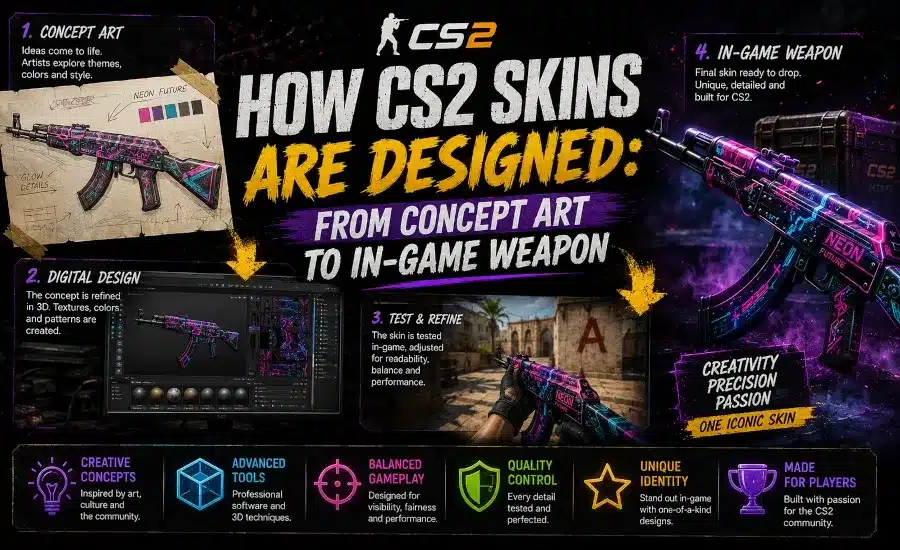
Counter-Strike 2 skins may look like simple cosmetic upgrades, but creating a successful weapon finish involves much more than placing artwork on a gun model.
Behind many popular CS2 skins is a combination of concept development, texture creation, weapon mapping, pattern design, technical testing, community feedback, and Valve’s selection process.
Some designs are relatively simple and focus on colors or realistic materials. Others use complex illustrations that must be carefully adapted to the shape of an AK-47, AWP, M4A1-S, Glock-18, or another weapon.
Understanding how CS2 skins are designed also helps explain why certain finishes become iconic while thousands of other community-created concepts never reach the game.
In this guide, we’ll explore how Counter-Strike weapon skins move from an initial idea to a finished cosmetic item players can potentially see inside CS2.
Quick Answer: How CS2 Skins Are Designed?
CS2 weapon skins can be created using Valve’s available workshop and development tools together with external graphics software.
A typical workflow involves:
- Developing a visual concept.
- Selecting a weapon.
- Creating or adapting the artwork.
- Mapping the design onto the weapon model.
- Configuring finish properties.
- Testing the skin under different conditions.
- Creating presentation materials.
- Publishing eligible community work to the Steam Workshop.
- Receiving community feedback.
- Potentially being selected by Valve for official Counter-Strike content.
Being popular in the Workshop does not guarantee that a skin will be added to Counter-Strike. Valve ultimately controls which community designs appear in official game content.
Why Skin Design Matters in Counter-Strike 2
Weapon skins have become one of Counter-Strike’s most recognizable features.
Players can build inventories around specific:
- colors,
- weapon families,
- artists,
- collections,
- rarity levels,
- patterns,
- esports themes.
However, a successful skin needs to work as more than a standalone piece of digital art.
The artwork must complement the geometry of the weapon.
An illustration that looks impressive as a flat image may become distorted or visually confusing when wrapped around a complex three-dimensional model.
That makes weapon design fundamentally different from creating a normal digital illustration.
From Idea to Weapon Finish
Most successful skin projects begin with a clear concept.
An artist might start with something as simple as:
“What would an AK-47 inspired by ancient mythology look like?”
or:
“Can I create a futuristic monochrome finish that remains recognizable during gameplay?”
From there, the idea develops into a broader visual direction.
Artists may research:
- historical references,
- architecture,
- mythology,
- science fiction,
- street art,
- animals,
- technology,
- typography,
- abstract patterns.
The strongest concepts usually have a recognizable identity rather than simply combining random colors.
Choosing the Right CS2 Weapon
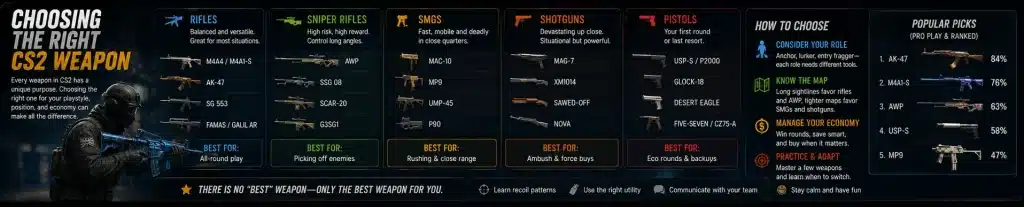
The weapon itself is an important part of the design process.
Different weapon models provide completely different creative opportunities.
An AWP offers a large surface for detailed artwork.
An AK-47 contains several visually distinct components that can be incorporated into the design.
A pistol provides much less space, forcing the artist to simplify the concept.
Popular design targets include:
- AK-47
- AWP
- M4A1-S
- M4A4
- Desert Eagle
- USP-S
- Glock-18
These weapons receive substantial attention partly because they are frequently used and highly visible during matches.
However, designing for a popular weapon also means competing against an enormous number of existing skins and Workshop submissions.
Understanding the Weapon Model
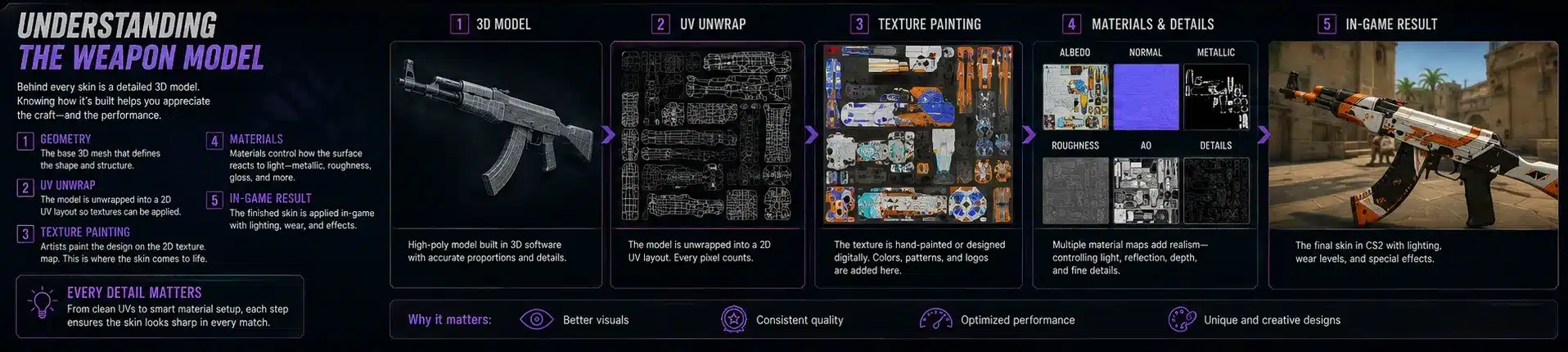
Before creating the final artwork, designers need to understand how the weapon’s three-dimensional model corresponds to its texture.
A weapon isn’t simply a flat rectangular canvas.
It contains:
- barrels,
- magazines,
- grips,
- stocks,
- receivers,
- scopes,
- suppressors,
- small mechanical components.
Artwork therefore needs to be positioned carefully.
A major part of skin creation involves determining where important visual elements should appear once the texture is applied to the weapon.
UV Mapping and CS2 Skin Design

One of the important concepts behind 3D texturing is UV mapping.
A UV map essentially represents the surface of a three-dimensional object in two dimensions.
Think of it like unfolding a cardboard box.
The box exists in 3D, but when unfolded its individual surfaces can be displayed on a flat sheet.
Artists can then create textures that correspond to those surfaces.
When the texture is applied back to the weapon model, the artwork appears in three dimensions.
This process allows artists to control where different visual elements appear on the weapon.
Why Placement Matters
Imagine creating a detailed dragon illustration for an AK-47.
If the texture is positioned poorly:
- the dragon’s head might disappear around an edge,
- important details could become hidden,
- the artwork could become distorted,
- major elements might appear on less visible parts of the weapon.
A strong design takes the weapon’s geometry into account from the beginning.
This is one reason some skins appear to “flow” naturally across the weapon while weaker designs look like images simply pasted onto a gun.
Different Types of Weapon Finishes
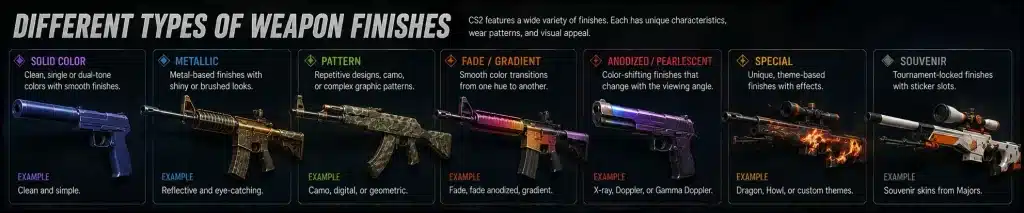
Not every CS2 skin is created using the same visual approach.
Counter-Strike supports different styles of weapon finishes, and the chosen finish method influences how artwork is applied.
Depending on the project, a design may rely on:
- repeating patterns,
- custom-painted artwork,
- solid colors,
- material-inspired finishes,
- hydrographic-style textures,
- metallic appearances,
- randomized pattern placement.
This diversity is one reason Counter-Strike inventories can look so different.
Pattern-Based Skins
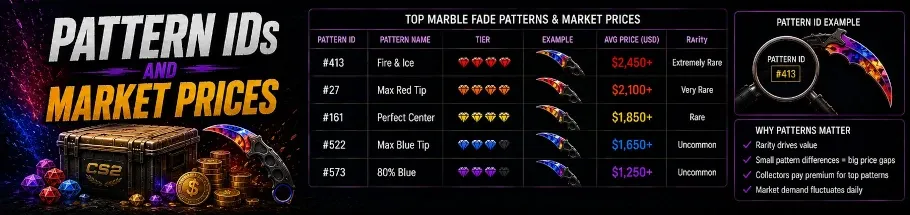
Some of the most fascinating Counter-Strike finishes use patterns rather than a completely fixed design.
Instead of every weapon looking exactly the same, the game can apply different sections of a larger texture according to a Pattern Seed.
This creates variations between individual examples of the same skin.
The most famous example is Case Hardened.
Different pattern placements can create combinations of:
- blue,
- gold,
- silver,
- purple.
A small number of highly desirable configurations are known by collectors as Blue Gems.
Pattern variation can therefore turn skin design into something much more dynamic than a single fixed illustration.
For a detailed explanation of this system, read our guide to CS2 Skin Patterns
Designing for Wear
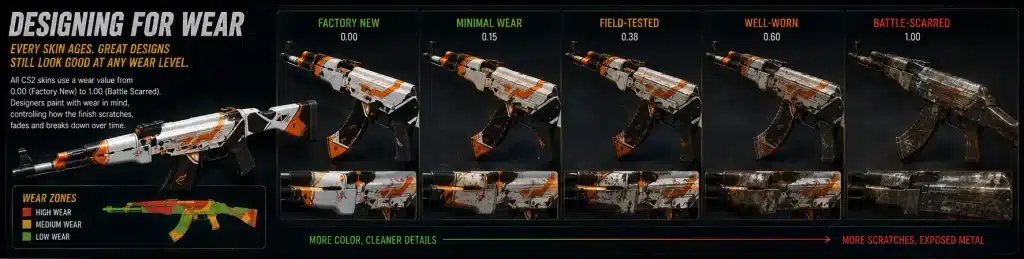
Another challenge is Counter-Strike’s wear system.
Individual skins can have different float values that influence their exterior condition.
The standard exterior categories are:
| Exterior | Typical Float Range |
|---|---|
| Factory New | 0.00–0.07 |
| Minimal Wear | 0.07–0.15 |
| Field-Tested | 0.15–0.38 |
| Well-Worn | 0.38–0.45 |
| Battle-Scarred | 0.45–1.00 |
Not every finish necessarily uses the entire possible float range, but the broader principle is important for designers: a skin may need to remain visually interesting even when wear becomes visible.
Why Wear Can Improve a Design
Wear isn’t always negative.
On certain skins, scratches and deterioration complement the artistic theme.
A military, industrial, post-apocalyptic, or distressed finish may actually gain character as wear becomes more visible.
This creates an interesting challenge for artists.
Instead of asking:
“How do I make the Factory New version perfect?”
a designer may also consider:
“How will this concept look in Field-Tested or Battle-Scarred condition?”
That can influence the entire design.
Designing for Counter-Strike’s Lighting
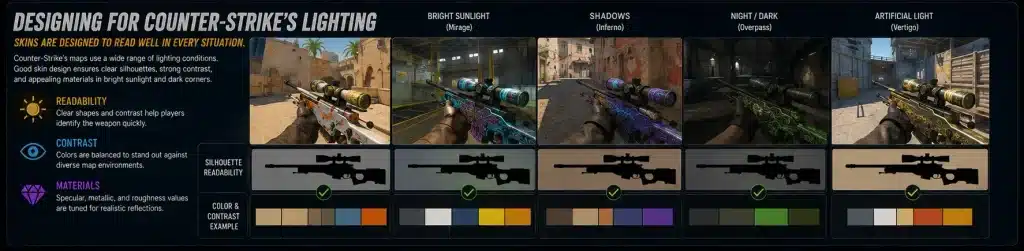
CS2 introduced major graphical changes through the Source 2 engine.
Lighting, materials, reflections, and weapon presentation can influence how a finish appears in-game.
A design that looks impressive inside graphics software may appear very different under actual gameplay conditions.
Artists therefore need to evaluate how colors and materials respond to different environments.
Important considerations include:
- brightness,
- contrast,
- reflections,
- material appearance,
- readability,
- color balance.
A visually complex skin can lose much of its impact if important details disappear under realistic lighting.
Readability Matters
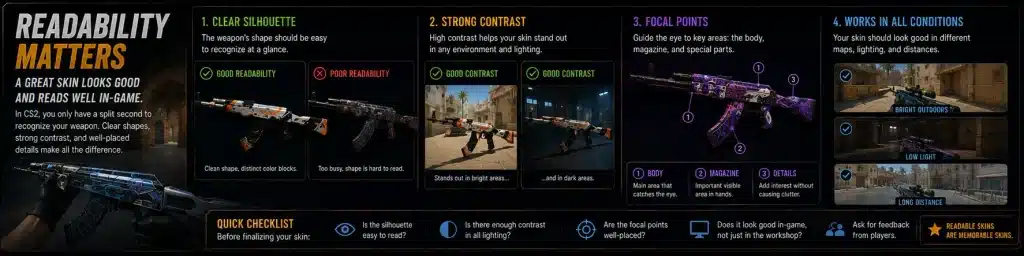
Counter-Strike is a fast-paced competitive game.
Players rarely spend an entire match examining their weapons from perfect angles.
A successful design therefore needs to remain recognizable at normal gameplay distances.
Strong silhouettes, clear color separation, and distinctive visual elements can help.
This partly explains why some relatively simple designs become extremely popular.
They remain immediately recognizable.
Creating a Visual Identity
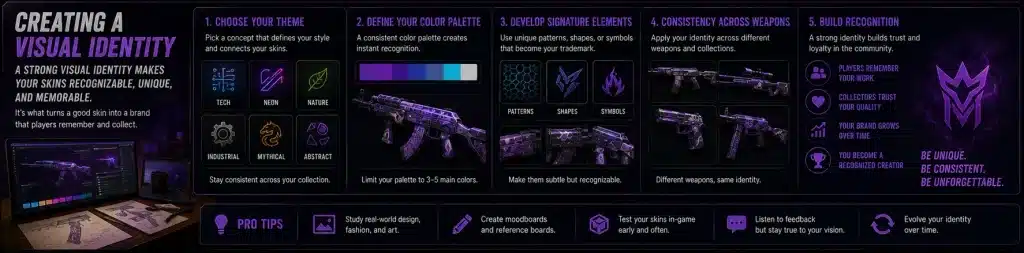
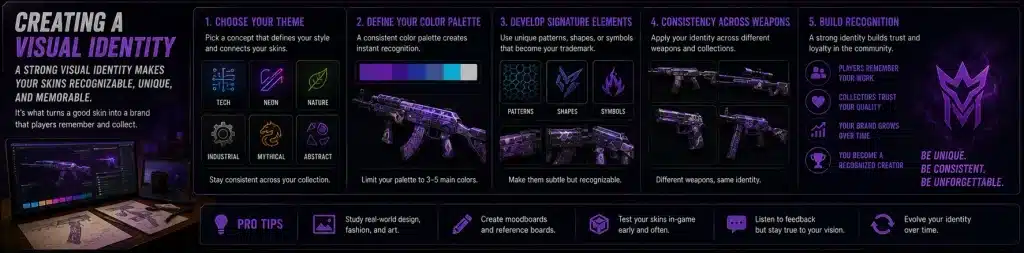
Many successful Counter-Strike skins belong to recognizable artistic families.
Players can sometimes identify a finish style without even reading the weapon name.
This is particularly powerful when artists develop multiple skins sharing:
- similar colors,
- typography,
- visual motifs,
- illustration styles,
- themes.
These design families can become highly recognizable within the community.
The Role of Community Artists
One of the most interesting aspects of Counter-Strike’s cosmetic ecosystem is the role of independent creators.
Community artists can create weapon finishes and submit eligible work through the Steam Workshop, where players can discover and evaluate designs.
This creates a connection between:
artists → community → Valve → Counter-Strike
Only a small fraction of submissions ultimately become official skins, but the Workshop provides creators with a direct route to showcase their work.
What Is the Steam Workshop?
The Steam Workshop serves as a community platform where creators can publish content for supported games.
For Counter-Strike skin artists, it provides a place to present weapon finish concepts and receive community feedback.
Players can discover submissions and express interest in designs they would like to see considered for the game.
However, Workshop popularity should not be confused with an automatic selection process.
Valve makes the final decision about which skins are included in official Counter-Strike releases.
What Makes a CS2 Skin Stand Out?
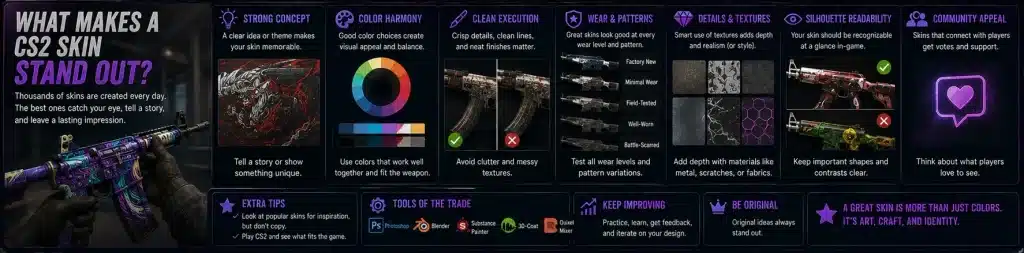
There is no guaranteed formula.
However, strong weapon skins often share several characteristics:
Clear Concept
Players can quickly understand the visual idea.
Strong Weapon Integration
Artwork follows the geometry rather than fighting against it.
Recognizable Appearance
The skin remains distinctive even during normal gameplay.
Balanced Detail
There is enough complexity to remain interesting without becoming visually chaotic.
Effective Color Palette
Colors complement each other and remain readable under different lighting.
Originality
The design brings something distinctive to an already enormous skin ecosystem.
Design Alone Does Not Determine Market Value
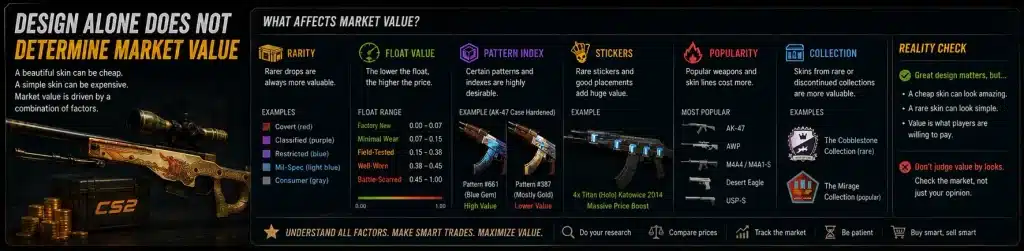
An important distinction needs to be made between artistic quality and market value.
A beautifully designed skin isn’t automatically expensive.
Market value can depend on:
- rarity,
- case or collection availability,
- float,
- Pattern ID,
- supply,
- demand,
- weapon popularity,
- collector interest.
Conversely, an older or visually simple skin can become extremely valuable because very few examples remain available.
Our guide to Rare CS2 Skins explains these factors in greater detail.
How Design Connects to the CS2 Skin Economy
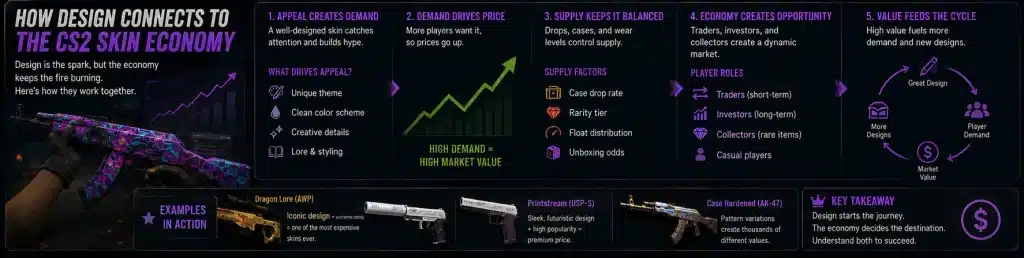
Artists create the visual identity.
Valve determines official inclusion and distribution mechanics.
Players create demand.
Collectors establish preferences.
Marketplaces provide secondary-market liquidity.
Together, these elements form the broader CS2 skin ecosystem.
If you want to understand the market side rather than the artistic side, start with our main guide:
You can also compare trading platforms here:
Expert Tip: Design for the Weapon, Not Around It
One of the most important principles in weapon skin creation is treating the weapon model as part of the artwork.
The best designs don’t simply place an illustration over a gun.
They use the magazine, receiver, stock, barrel, scope, and other components as elements of the composition.
When the artwork and weapon geometry work together, the result feels like a genuine weapon finish rather than a flat image wrapped around a model.
reating the initial concept is only the first stage of designing a Counter-Strike 2 skin.
Once an artist has decided on a theme, weapon, and general visual direction, the real production process begins. The idea must be transformed into artwork that works correctly on a three-dimensional weapon, remains attractive under CS2’s lighting, reacts convincingly to materials and wear, and looks good from the angles players actually see during gameplay.
This is where skin creation becomes a combination of digital art, 3D texturing, technical knowledge, and iterative testing.
Step 1: Developing the Concept
Professional-quality CS2 skins usually begin with more planning than players might expect.
Before producing the final texture, an artist may create:
- reference boards,
- rough sketches,
- color studies,
- composition tests,
- weapon mockups,
- alternative versions of the same concept.
The objective is to establish a clear visual identity before investing significant time in detailed artwork.
For example, an artist designing a futuristic M4A1-S might decide early that the skin should use:
- a predominantly white body,
- black mechanical details,
- subtle reflective elements,
- small red accents.
That creates a visual framework for every decision that follows.
Step 2: Research and Reference Gathering
Many memorable skins are built around recognizable themes.
Artists may research subjects such as:
- mythology,
- ancient civilizations,
- military equipment,
- cyberpunk,
- science fiction,
- animals,
- graffiti,
- architecture,
- technology,
- comics,
- traditional artwork.
Reference material helps maintain visual consistency.
However, originality is critical.
A Workshop submission should not simply reproduce copyrighted artwork, logos, characters, or other intellectual property without appropriate rights.
For artists hoping to see their work selected for Counter-Strike, creating original assets is essential.
Step 3: Building the Color Palette
Color is one of the first things players notice about a skin.
Some of Counter-Strike’s most recognizable finishes use very strong palettes.
Think about combinations such as:
- black and white,
- red and black,
- blue and gold,
- neon pink and purple,
- green and black.
The goal isn’t necessarily to use many colors.
Often, limiting the palette creates a stronger identity.
Why Contrast Is Important
A skin needs enough contrast for important elements to remain visible.
Low-contrast artwork may look impressive when viewed closely but become difficult to recognize during normal gameplay.
Artists therefore need to consider:
Primary color — dominates the design.
Secondary color — supports the primary palette.
Accent color — highlights important elements.
A carefully controlled palette can make even a relatively simple skin instantly recognizable.
Step 4: Creating the Main Artwork
Once the concept and palette are established, the artist begins creating the primary visual assets.
Depending on the skin, this might involve:
- digital painting,
- vector illustration,
- geometric patterns,
- procedural textures,
- hand-drawn artwork,
- realistic materials.
Complex skins can require dozens of individual layers.
Artists may separate:
- background,
- characters,
- outlines,
- highlights,
- shadows,
- mechanical details,
- decorative elements.
Working in layers makes later adjustments significantly easier.
Designing Around Weapon Geometry
One of the biggest mistakes beginners make is creating the artwork first and thinking about the weapon afterward.
Professional skin design often works the other way around.
The weapon’s geometry should influence the composition from the beginning.
For example, an AK-47 naturally provides several separate visual areas:
- receiver,
- magazine,
- stock,
- handguard,
- barrel area.
An artist can use those components to divide the design into different visual zones.
Instead of fighting the geometry, the artwork becomes part of it.
Step 5: Applying the Texture to the Weapon
Once enough artwork exists, it must be mapped onto the weapon.
This is where the UV layout discussed in Part 1 becomes extremely important.
The artist needs to check:
- where major elements appear,
- whether seams are visible,
- whether artwork becomes stretched,
- whether important features are hidden,
- whether the design aligns across different weapon components.
This process often requires many revisions.
The Problem of Texture Seams
A texture may appear continuous in a graphics editor but reveal obvious breaks once applied to a 3D weapon.
These breaks are called seams.
Poorly handled seams can make otherwise excellent artwork look unfinished.
Artists therefore adjust textures repeatedly until transitions between different sections appear natural.
Step 6: Understanding Finish Styles
Counter-Strike doesn’t treat every skin texture in exactly the same way.
Different finish approaches can create very different visual results.
A designer may choose a style that emphasizes:
- custom artwork,
- repeating patterns,
- realistic materials,
- metallic surfaces,
- solid colors,
- randomized textures.
Choosing the appropriate finish approach is important because it influences both appearance and how the skin varies between individual items.
Fixed Artwork vs Randomized Patterns
This distinction is particularly important.
Some skins are designed so that the artwork appears in essentially the intended position on each weapon.
Others use patterns that can shift depending on the item’s Pattern Seed.
Randomized finishes can create significant visual variation.
This is the foundation behind collector phenomena such as:
- Case Hardened Blue Gems,
- different Fade percentages,
- Crimson Web placement,
- some pattern-dependent finishes.
You can learn more about these variations in our dedicated CS2 Skin Patterns Explained guide:
Step 7: Materials and Surface Appearance
Modern weapon finishes aren’t only about color.
Material properties influence how a skin reacts to light.
Artists need to consider whether a surface should appear:
- metallic,
- painted,
- glossy,
- matte,
- rough,
- polished,
- reflective.
These properties can dramatically change the final result.
A gold-colored area that behaves like flat paint won’t create the same visual impression as a surface designed to resemble polished metal.
Designing for Source 2
Counter-Strike 2’s Source 2 rendering system places significant emphasis on modern materials and lighting.
This means designers need to evaluate skins in multiple lighting environments.
A weapon may look completely different:
- in direct sunlight,
- inside a dark corridor,
- under artificial lighting,
- during an inspect animation.
Good designs maintain their identity across these conditions.
Step 8: Testing the Skin
Testing is one of the most important stages of the design process.
Artists shouldn’t judge a skin solely from a flat texture.
They need to evaluate it on the actual weapon model.
Questions to ask include:
Does the skin look good from first-person view?
This is arguably the most important perspective because it’s what the owner sees during normal gameplay.
Does the inspect animation reveal interesting details?
Premium skins often reward players who examine them closely.
Are important elements visible?
Major artwork shouldn’t disappear onto an obscure section of the weapon.
Does the design remain readable?
Highly detailed artwork can become visually confusing when scaled down.
Does the material react properly to light?
Overly reflective or excessively dark areas can reduce visual quality.
Step 9: Testing Different Wear Conditions
A skin doesn’t exist only in Factory New condition.
Depending on the finish’s allowed float range, players may encounter versions across multiple exterior categories.
Artists therefore need to consider how the design responds to wear.
A skin might look excellent at:
0.03 Factory New
but significantly less appealing at:
0.35 Field-Tested.
Sometimes that’s expected.
In other cases, the designer may adjust the finish to preserve important visual elements.
Wear as an Artistic Tool
Experienced artists can use wear creatively.
Imagine an industrial skin where scratches expose bare metal underneath.
As the float increases, the weapon gradually becomes more rugged.
That means the wear system becomes part of the design rather than simply degrading it.
This approach can create skins where players intentionally prefer higher-wear versions.
Step 10: Iteration
Very few professional-quality skins are perfect on the first attempt.
Artists often repeat the same process many times:
Create → Import → Inspect → Adjust → Test → Repeat
A design may go through dozens of revisions before the creator is satisfied.
Common changes include:
- moving artwork,
- increasing contrast,
- simplifying details,
- changing colors,
- adjusting materials,
- correcting seams,
- improving wear behavior.
This iterative process is one of the biggest differences between a rough concept and a polished Workshop submission.
Creating Workshop Presentation Images
Once the skin itself is finished, presentation becomes important.
Thousands of designs compete for attention.
A poorly presented skin may be overlooked even if the underlying artwork is excellent.
Creators typically prepare images showing:
- full weapon view,
- first-person perspective,
- close-up details,
- important design elements,
- alternative angles.
The objective is to communicate the concept clearly without hiding what the actual weapon finish looks like.
Why Workshop Presentation Matters
Players browsing Workshop submissions often make their first decision within seconds.
A strong thumbnail can encourage them to inspect the project.
However, presentation shouldn’t misrepresent the skin.
Overly edited promotional images can create unrealistic expectations.
The strongest submissions allow the actual design to speak for itself.
Step 11: Publishing to the Steam Workshop
Once a community-created finish is ready, eligible content can be submitted through the relevant Steam Workshop process.
A Workshop listing typically allows the creator to showcase the design and provide information about the project.
The community can then discover the submission and provide feedback.
This gives artists exposure and helps Valve identify community interest.
But there is an important distinction.
Workshop Popularity Does Not Guarantee Selection
A highly rated or widely shared Workshop skin is not automatically added to Counter-Strike.
Valve controls official content selection.
Community reaction may provide useful signals, but many other considerations can affect whether a design is ultimately chosen.
What Might Valve Look for in a Skin?
Valve does not provide creators with a simple formula guaranteeing acceptance.
Nevertheless, designs suitable for Counter-Strike generally need to work within the game’s technical and content requirements.
Factors that can matter include:
- originality,
- technical quality,
- visual readability,
- weapon compatibility,
- thematic suitability,
- overall polish.
A skin may be beautiful yet still not fit the needs of a particular collection or release.
Competition Is Extremely High
Counter-Strike’s Workshop contains an enormous amount of community-created content.
Only a small portion becomes official game content.
This means talented artists may create multiple high-quality designs without ever seeing one selected.
Successful creators therefore often treat skin design as a long-term creative process rather than expecting immediate results from a single submission.
Community Feedback Can Improve a Skin
Workshop feedback can be valuable even when a submission isn’t selected.
Players may point out:
- weak color combinations,
- unreadable details,
- awkward texture placement,
- similarities to existing skins,
- sections that could use more polish.
Creators can use this feedback to refine future work.
Over time, this helps artists better understand what works within Counter-Strike’s unique visual environment.
Building a Recognizable Artist Style
Some creators develop distinctive visual styles across multiple Workshop submissions.
This can include recurring:
- color palettes,
- illustration techniques,
- characters,
- typography,
- futuristic themes,
- mechanical motifs.
A recognizable style helps establish an artist’s identity within the community.
It can also create natural skin families that players may want to collect together.
From Workshop Submission to Valuable Collectible
An interesting transformation occurs when a community design becomes an official Counter-Strike item.
The artist created the artwork.
But once the skin enters the game, additional systems begin influencing individual items.
These include:
- rarity tier,
- distribution method,
- float values,
- Pattern Seeds,
- supply,
- player demand.
The original artwork may therefore become the foundation for thousands of individual digital items with different market values.
Design Quality vs Skin Price
This distinction is critical.
Design quality does not directly determine price.
Consider two excellent skins.
One may be widely available and cost only a few dollars.
Another might come from a discontinued collection and cost thousands.
The difference isn’t necessarily artistic quality.
It’s often economics.
| Factor | Design Related? | Can Affect Price? |
|---|---|---|
| Artwork Quality | ✅ | ✅ |
| Weapon Popularity | ❌ | ✅ |
| Rarity Tier | ❌ | ✅ |
| Float Value | ❌ | ✅ |
| Pattern Seed | Partly | ✅ |
| Collection Supply | ❌ | ✅ |
| Collector Demand | ❌ | ✅ |
| Sticker Craft | ❌ | ✅ |
This separation between artistic design and market economics is essential for understanding the CS2 skin ecosystem.
Why Some Simple Designs Become Iconic
More detail doesn’t automatically create a better skin.
Some of Counter-Strike’s most recognizable finishes succeed because they’re simple.
Strong skins may rely on:
- one distinctive color,
- clean geometry,
- recognizable symbols,
- strong contrast,
- memorable patterning.
Complex illustrations can be impressive, but simplicity often improves readability during gameplay.
The best design depends on the concept.
Can Anyone Design a CS2 Skin?
From a creative perspective, skin design is accessible to anyone willing to learn the required tools and workflow.
You don’t necessarily need to begin as an experienced professional artist.
However, producing high-quality Workshop content requires developing several skills:
- digital illustration,
- texture creation,
- basic 3D understanding,
- UV mapping,
- material design,
- composition,
- color theory,
- technical testing.
The combination makes CS2 skin design an interesting entry point into broader game-art and 3D-texturing skills.
How Long Does It Take to Design a CS2 Skin?
There is no universal answer.
A relatively simple pattern-based design might be created quickly, while an elaborate illustrated finish can require many hours—or considerably longer—of development and revision.
The time required depends on:
- artistic complexity,
- experience,
- number of revisions,
- texture issues,
- material setup,
- testing,
- presentation work.
For professional-quality results, iteration often consumes more time than creating the initial concept.
Common Beginner Mistakes
New CS2 skin designers frequently make several predictable mistakes.
1. Starting With Too Much Detail
Complexity can become difficult to control.
Start with a strong overall composition before adding small details.
2. Ignoring the Weapon Geometry
The weapon isn’t a blank rectangular canvas.
Design around its physical shape.
3. Using Too Many Colors
A limited palette often creates stronger visual identity.
4. Testing Only One Angle
Players see the weapon from multiple perspectives.
5. Ignoring Wear
Check how the finish behaves across its intended exterior range.
6. Copying Existing Concepts Too Closely
Originality matters both creatively and from an intellectual-property perspective.
7. Focusing Only on Workshop Thumbnails
Presentation matters, but the actual in-game finish matters more.
Before you decide to buy skins in CS2 please first check the CS2 skin quality and CS2 skins rarity.
Expert Tip: Test Early, Not Just at the End
Don’t wait until you’ve finished every detail before applying your artwork to the weapon.
Testing early helps reveal problems with UV placement, proportions, readability, and seams before you’ve invested hours polishing artwork that may need to be moved or redesigned.
A better workflow is:
Sketch → Test → Refine → Test → Detail → Test → Finalize
rather than:
Finish everything → Test once.
How Skin Creation Connects to Collecting
Understanding how skins are designed also makes it easier to appreciate why collectors value certain details.
Collectors don’t only see an AK-47 or AWP.
They may notice:
- artwork placement,
- finish type,
- wear behavior,
- Pattern Seed,
- visual symmetry,
- rare variations.
For a deeper look at collector rarity, read:
And for pattern-specific variations:
Our main CS2 Skins guide covers the broader ecosystem
From Steam Workshop to Counter-Strike 2
The Steam Workshop gives artists a way to present their weapon finishes to the Counter-Strike community.
However, there is no simple formula such as:
Most votes = automatic inclusion.
Community reception can help demonstrate interest, but Valve ultimately decides which designs fit upcoming content.
This distinction is important because Valve may need skins that complement a particular:
- weapon case,
- collection,
- visual theme,
- rarity distribution,
- weapon lineup.
An excellent skin might therefore remain outside the game simply because it doesn’t fit the requirements of a particular release.
How Valve Selects CS2 Skins
Valve doesn’t publicly provide a scoring system that allows creators to calculate their chances of selection.
Instead, Workshop artists need to create designs that satisfy technical requirements while also standing out creatively.
Several characteristics can make a submission stronger.
Originality
Counter-Strike already contains thousands of weapon finishes.
A new skin therefore needs a distinctive identity.
Simply producing another version of an existing popular concept is unlikely to make a design memorable.
Visual Quality
The artwork should look polished both in promotional images and on the actual weapon.
Important considerations include:
- texture quality,
- composition,
- color balance,
- material behavior,
- readability.
Weapon Integration
The strongest designs use the weapon’s geometry intelligently.
Artwork should feel like it belongs on the AK-47, AWP, M4A1-S, Desert Eagle, or other model rather than appearing randomly placed.
Technical Compatibility
A visually impressive concept still needs to function correctly within Counter-Strike’s skin system.
Technical problems can undermine otherwise excellent artwork.
Distinctiveness
Players should ideally be able to recognize a skin quickly.
This can come from:
- unusual colors,
- recognizable illustrations,
- strong silhouettes,
- memorable themes,
- unique materials.
Why Workshop Votes Still Matter
Workshop ratings don’t guarantee selection, but community response can still be valuable.
Positive engagement can demonstrate that players find a concept appealing.
Creators also gain useful feedback from comments and discussions.
This creates a cycle:
Create → Publish → Receive Feedback → Improve → Create Again
For many artists, Workshop participation becomes a long-term process rather than a one-time submission.
What Happens When Valve Selects a Skin?
When Valve chooses community artwork for official Counter-Strike content, the design can eventually appear as part of a new release.
Depending on Valve’s plans, that might involve a:
- weapon case,
- collection,
- operation-related release,
- other cosmetic update.
Once officially released, players can begin obtaining the item according to the distribution system Valve has assigned to it.
At that point, something interesting happens.
The artwork stops being only an artist’s design and becomes part of the CS2 economy.
From Artwork to Thousands of Individual Items
Suppose an artist creates an AK-47 finish that Valve selects.
Once released, players may obtain thousands of individual copies.
But those copies aren’t necessarily identical.
Individual examples can differ because of factors such as:
- Float Value
- Exterior condition
- Pattern Seed
- StatTrak availability, where applicable
Players can then apply stickers and other supported customization elements.
One original design can therefore produce a large ecosystem of individual collectible items.
Rarity Tier Changes Everything
When a skin enters Counter-Strike, its assigned rarity becomes an important part of its market identity.
Counter-Strike uses a hierarchy of weapon finish rarity levels commonly represented through colors.
These include categories such as:
| Rarity | Common Color Association |
|---|---|
| Consumer Grade | White |
| Industrial Grade | Light Blue |
| Mil-Spec | Blue |
| Restricted | Purple |
| Classified | Pink |
| Covert | Red |
Special rare items such as knives and gloves occupy a separate position within the case ecosystem.
Rarity directly affects how frequently an item may appear through the relevant acquisition system.
This can have a major influence on supply.
Design Quality and Rarity Are Different Things
One common misconception is that the most beautiful skin must receive the highest rarity.
That isn’t necessarily how the system works.
A visually sophisticated design could appear at a lower rarity, while another skin might become Covert.
Valve needs to balance the overall composition of a case or collection.
This means rarity is part of the content structure, not simply a rating of artistic quality.
Why Weapon Choice Matters After Selection
The popularity of the weapon can significantly influence demand.
Skins for frequently used weapons often attract more attention.
Examples include:
- AK-47
- AWP
- M4A1-S
- M4A4
- Desert Eagle
- USP-S
- Glock-18
A visually impressive skin for a less frequently used weapon may still be collectible, but the potential audience can be smaller.
This is why weapon popularity becomes another important component of market value.
How CS2 Skin Creators Can Be Compensated
The possibility of earning money is one reason the Counter-Strike Workshop attracts professional-quality artists.
When community-created content is officially selected and used by Valve, creators can potentially receive compensation under the applicable Steam Workshop and Valve terms.
The exact arrangements depend on the relevant agreements and content system, so creators should always review Valve’s current official Workshop documentation rather than relying on outdated community estimates.
The important point is that the Workshop isn’t simply an art gallery.
It can provide a pathway for community artists to contribute officially to one of the world’s largest multiplayer games.
Why This Model Is Important
Valve’s community-driven content model creates benefits on several levels.
Players
Receive a steady stream of creative weapon finishes.
Artists
Gain access to an enormous audience and potential commercial opportunities.
Valve
Can draw from a large pool of independent creative talent.
Counter-Strike
Maintains a visual style constantly influenced by its own community.
This relationship has played a major role in the longevity of the skin ecosystem.
From New Skin to Iconic Skin
Selection by Valve doesn’t automatically make a skin legendary.
Most new finishes enter a highly competitive market.
Only some become enduring community favorites.
So what separates an ordinary skin from an icon?
Several factors can contribute.
1. Memorable Design
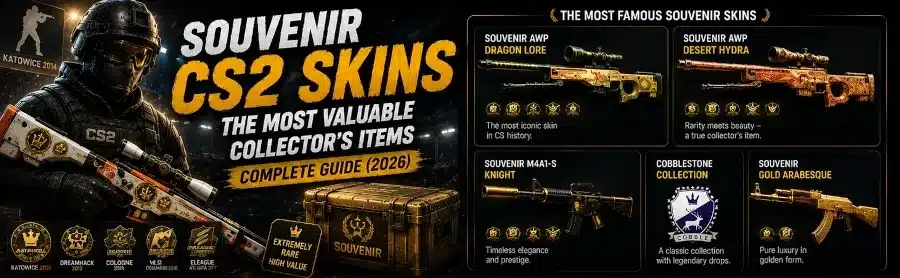
Iconic skins are easy to recognize.
A player may identify them instantly from:
- color,
- silhouette,
- illustration,
- pattern,
- distinctive theme.
This recognition gives a skin cultural value beyond its rarity.
2. The Right Weapon
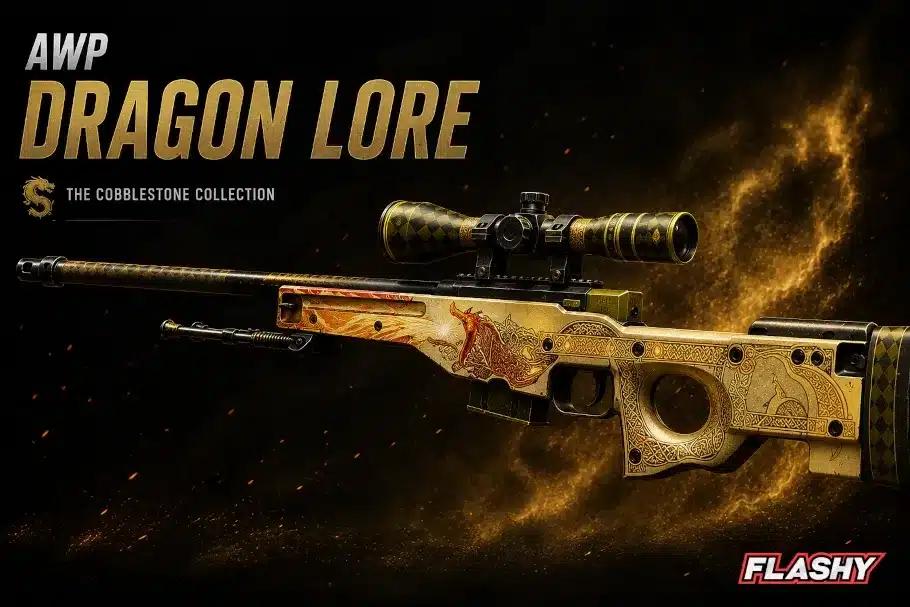
A memorable finish on a popular weapon has a major advantage.
An AK-47 or AWP skin can appear constantly in:
- professional matches,
- streams,
- highlight videos,
- screenshots,
- inventory showcases.
Repeated exposure helps establish the skin within Counter-Strike culture.
3. Scarcity
Supply can dramatically affect collector perception.
A skin associated with a limited or discontinued source can become increasingly difficult to obtain over time.
If demand remains strong while supply becomes constrained, collector premiums can develop.
Our Rare CS2 Skins guide explains this relationship in more detail
4. Pattern Variations
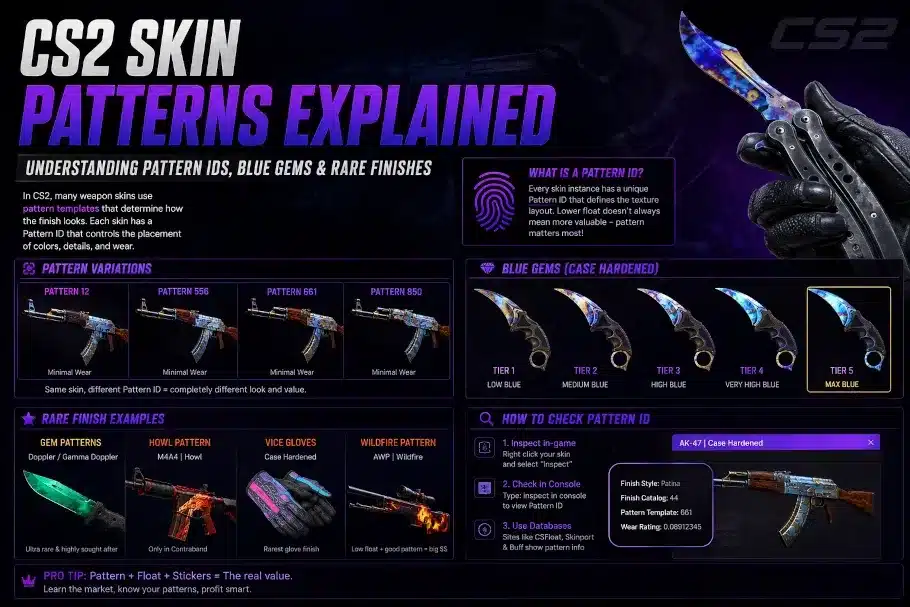
Pattern-based skins can develop their own collector hierarchy.
A normal version may have one price.
An exceptional pattern may command a dramatically higher premium.
The most obvious example is Case Hardened, where certain blue-heavy configurations have become famous as Blue Gems.
Learn how Pattern Seeds
5. Float Rarity
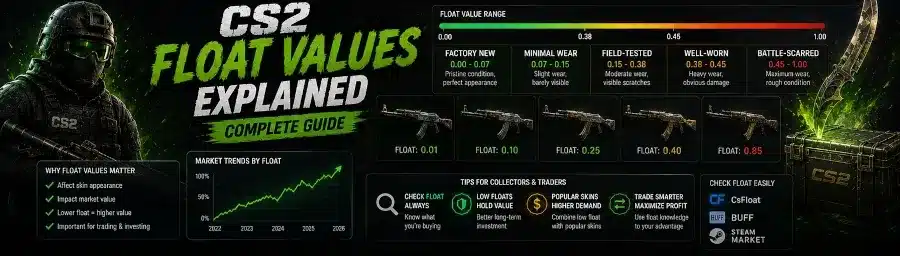
Even fixed-design skins can produce unusual individual examples.
Collectors may search for:
- extremely low floats,
- extremely high floats,
- top-ranked floats,
- specific wear appearances.
That means an ordinary design can still produce extraordinary individual items.
6. Esports Exposure
Professional Counter-Strike has enormous influence on skin visibility.
When a famous player consistently uses a particular skin, millions of viewers may see it during tournaments.
This exposure can increase community interest.
Professional players also create memorable associations between skins and competitive moments.
A weapon finish used during a legendary clutch or Major final can become culturally connected to Counter-Strike history.
CS2 Skins and Esports
The relationship between skins and esports extends far beyond professionals using expensive inventories.
Counter-Strike tournaments have their own cosmetic ecosystem involving:
- tournament stickers,
- team stickers,
- player autographs,
- Souvenir Packages,
- Souvenir skins.
This connects digital cosmetics directly with competitive history.
A collector can own an item associated with a specific Major, team, or player.
That creates something ordinary cosmetics cannot easily replicate:
provenance.
Why Provenance Matters to Collectors
Collectors often value stories.
A rare item becomes more interesting when it has historical context.
This concept exists in traditional collectibles as well.
A signed sports jersey is more valuable because of who signed it.
A historic watch can command a premium because of its previous owner.
In Counter-Strike, provenance may involve:
- famous inventories,
- legendary sticker combinations,
- Major tournaments,
- notable professional players,
- historically important trades.
The skin itself hasn’t changed.
Its story has.
Stickers Can Transform the Original Design
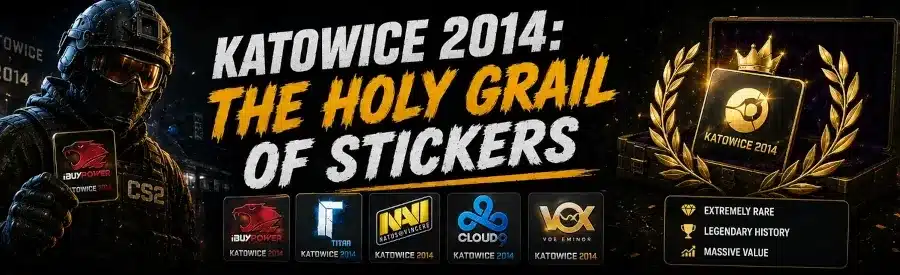
A weapon skin doesn’t necessarily remain visually identical after entering a player’s inventory.
Stickers allow owners to create their own compositions on top of the original artwork.
This produces an interesting collaboration between:
Original artist + Valve + Player
The artist establishes the base design.
Valve integrates it into the game.
The player personalizes it.
Some sticker crafts become famous enough to develop collector value independent of the base skin.
When Stickers Are Worth More Than the Skin
In high-end collecting, the applied stickers can sometimes be more important than the weapon finish underneath them.
This is particularly relevant to older tournament stickers and famous crafts.
Collectors may evaluate:
- sticker rarity,
- placement,
- condition,
- visual compatibility,
- number of matching stickers.
A relatively inexpensive weapon can therefore become a highly specialized collector piece.
Skin Design Trends Change Over Time
Counter-Strike’s visual culture isn’t static.
Design trends evolve.
Earlier skins often relied more heavily on:
- straightforward camouflage,
- simple colors,
- traditional weapon finishes.
Over time, community designs became increasingly ambitious.
Modern skins can feature:
- elaborate illustrations,
- futuristic materials,
- anime-inspired aesthetics,
- neon palettes,
- detailed characters,
- complex graphic compositions.
This evolution reflects both improvements in artist skill and changes in community taste.
Why Simple Skins Still Work
Despite the trend toward more complex artwork, simple skins haven’t disappeared.
Minimalist designs remain popular because they can be:
- clean,
- easy to recognize,
- versatile,
- compatible with stickers,
- suitable for themed inventories.
A successful skin doesn’t need maximum visual complexity.
It needs a clear identity.
How Collectors Influence Design Trends
Artists don’t work in isolation.
They can observe what players collect.
If certain visual styles become popular, more Workshop submissions may explore similar directions.
Examples might include increased interest in:
- black-and-white finishes,
- neon designs,
- Japanese-inspired artwork,
- luxury aesthetics,
- cyberpunk themes,
- highly reflective materials.
However, following trends too closely creates another problem.
If hundreds of creators imitate the same aesthetic, originality disappears.
The strongest artists often understand current trends while still developing their own recognizable style.
The Role of Market Value in Skin Perception
Once a skin becomes expensive, player perception can change.
An item that might initially have been judged purely on appearance can become a status symbol.
High prices create:
- prestige,
- exclusivity,
- collector attention,
- social-media visibility.
This can reinforce demand.
But expensive does not necessarily mean better designed.
Market price and artistic quality remain separate concepts.
How Third-Party Marketplaces Changed Collecting
The expansion of third-party marketplaces made it easier for collectors to search for very specific items.
Instead of simply looking for “Karambit Case Hardened,” buyers can potentially compare individual examples according to characteristics such as:
- float,
- Pattern Seed,
- price,
- exterior,
- stickers.
This improved price discovery and helped transform skin collecting into a much more specialized market.
Our marketplace comparison is available here:
Individual marketplace pages already available on FlashyFlashy include:
Social Media and Skin Design
Modern skin artists also operate in a very different environment from creators in the early CS:GO era.
Designs can spread rapidly through:
- X,
- Reddit,
- YouTube,
- TikTok,
- Discord,
- Steam communities.
A visually striking Workshop concept can attract substantial attention before it ever appears in the game.
This gives creators opportunities to build audiences around their work.
But viral popularity still doesn’t guarantee official selection.
AI and the Future of CS2 Skin Design
Generative AI is increasingly influencing digital art, creating both opportunities and challenges for creative communities.
Artists can potentially use modern tools for:
- brainstorming,
- reference exploration,
- color experimentation,
- early concept development.
However, creators need to pay particular attention to originality, ownership, intellectual-property rights, and Valve’s current submission requirements.
For Workshop submissions, the creator must be able to comply with the applicable rules governing the content they submit.
As tools evolve, provenance and authorship may become increasingly important parts of digital asset creation.
Will CS2 Skin Design Become More Advanced?
Almost certainly.
Counter-Strike 2 provides a modern technical foundation that can support increasingly sophisticated cosmetic content.
Future designs may make greater use of:
- advanced materials,
- complex surface effects,
- richer 3D customization,
- charms,
- new sticker systems,
- improved lighting interactions.
Valve can also introduce entirely new cosmetic categories.
The history of Counter-Strike suggests that customization will continue evolving alongside the game.
Could Valve Introduce More Customization?
Charms demonstrate that weapon skins don’t have to be the final stage of customization.
Future additions could potentially expand how players personalize:
- weapons,
- inventories,
- profiles,
- equipment.
However, one principle is likely to remain crucial:
cosmetics should not provide a competitive advantage.
This separation between customization and gameplay has been fundamental to Counter-Strike’s cosmetic success.
The Future of Community Artists
Community creators are likely to remain an important part of Counter-Strike’s identity.
The Workshop gives Valve access to artistic ideas from creators around the world.
This creates an almost unlimited source of:
- artistic styles,
- cultural influences,
- visual concepts,
- experimentation.
For aspiring game artists, CS2 skin design can also function as a practical portfolio exercise.
Creating a professional weapon finish requires many skills used throughout the games industry:
- concept development,
- texturing,
- 3D awareness,
- material creation,
- presentation,
- iteration.
Even a design that is never selected can therefore provide valuable experience.
Can You Make Money Designing CS2 Skins?
Potentially, yes—but this should not be treated as guaranteed income.
Getting a Workshop submission officially selected is highly competitive.
Thousands of creators can submit content, while only a limited number of designs are ultimately used.
For that reason, aspiring artists should approach skin creation primarily as:
creative work + portfolio development + community participation
rather than assuming every submission will generate revenue.
If Valve selects eligible community content, the creator may be compensated according to the applicable agreements and terms.
Always consult Valve’s current official documentation for the exact rules.
What Makes a Successful CS2 Skin Artist?
Looking across the entire design process, several characteristics stand out.
Successful creators tend to combine:
Artistic Skill
They understand composition, color, illustration, and visual hierarchy.
Technical Knowledge
They know how textures and materials behave on 3D weapon models.
Originality
Their work has a recognizable identity.
Iteration
They aren’t afraid to revise designs repeatedly.
Understanding of Counter-Strike
They know how weapons appear during actual gameplay.
Patience
Workshop selection is highly competitive.
No single characteristic guarantees success.
Together, however, they dramatically improve the quality of the work.
From Artist to Player: The Complete CS2 Skin Lifecycle
We can now summarize the entire process.
| Stage | What Happens |
|---|---|
| 1. Concept | Artist develops the idea |
| 2. Research | References and visual direction are established |
| 3. Artwork | Textures and illustrations are created |
| 4. Mapping | Artwork is adapted to the weapon model |
| 5. Materials | Surface properties are configured |
| 6. Testing | Skin is examined in-game |
| 7. Iteration | Problems are corrected |
| 8. Workshop | Eligible design is submitted |
| 9. Community | Players discover and evaluate it |
| 10. Valve Selection | Valve may choose the design |
| 11. Official Release | Skin enters Counter-Strike |
| 12. Distribution | Individual examples enter circulation |
| 13. Trading | Players buy, sell, or trade eligible items |
| 14. Collecting | Rare variants may develop premiums |
| 15. Legacy | Some skins become Counter-Strike icons |
What begins as a blank digital canvas can eventually become an item recognized by millions of players.
Why CS2 Skin Design Is Unique
Few gaming ecosystems combine all of these elements simultaneously:
community art + official game integration + randomized item characteristics + trading + collecting + esports + digital ownership
That’s what makes Counter-Strike skin design particularly interesting.
The artist creates the foundation.
But once a skin enters the ecosystem, players create much of its subsequent history.
Expert Tip
If you’re designing your first CS2 skin, don’t begin by trying to create “the next $10,000 skin.”
Market value is largely outside the artist’s control.
Instead, focus on what you can control:
- originality,
- technical execution,
- readability,
- weapon integration,
- presentation.
A strong design should work as artwork even before rarity, float values, collector demand, or market prices enter the equation.
Continue Exploring CS2 Skins
To understand what happens after a skin enters the Counter-Strike economy, continue with these FlashyFlashy guides:
These articles create a natural path through the silo:
How Skins Are Designed → CS2 Skins → Patterns → Rarity → Trading
Frequently Asked Questions About CS2 Skin Design
How are CS2 skins designed?
CS2 skins are created by designing textures and visual concepts that are adapted to Counter-Strike weapon models. Artists need to consider UV mapping, weapon geometry, colors, materials, lighting, wear behavior, and how the finish appears during normal gameplay.
Community creators can submit eligible designs through the Steam Workshop, but Valve decides which skins become official Counter-Strike items.
Can anyone create a CS2 skin?
Yes. Artists can learn the tools and techniques required to create Counter-Strike weapon finishes.
However, creating a professional-quality skin requires more than basic image editing. Designers benefit from skills in:
- digital illustration,
- 3D texturing,
- UV mapping,
- material creation,
- color theory,
- composition,
- technical testing.
Beginners can start with relatively simple designs and gradually learn more advanced techniques.
What software is used to create CS2 skins?
Artists commonly combine Valve’s available Counter-Strike Workshop tools with external graphics and 3D software.
The exact workflow varies depending on the creator and type of finish.
A designer might use separate software for:
- illustration,
- texture editing,
- vector graphics,
- 3D visualization,
- material creation.
The most important requirement isn’t a particular software package but producing files that comply with Valve’s current technical and Workshop submission requirements.
What is UV mapping in CS2 skin design?
UV mapping is the process of representing the surface of a three-dimensional weapon model as a two-dimensional layout.
Artists use this layout to determine where different parts of their texture will appear on the weapon.
Good UV-aware design helps prevent problems such as distorted illustrations, broken patterns, poorly positioned artwork, and visible texture seams.
What is a Pattern Seed in CS2?
A Pattern Seed, often called a Pattern ID, determines how certain pattern-based textures are positioned on an individual weapon.
For some finishes, different seeds can create dramatically different appearances.
This is particularly important for collector-focused finishes such as Case Hardened, where certain blue-heavy patterns can command substantial premiums.
Read our complete guide:
Does float value affect how a skin is designed?
Float values determine the wear condition of individual weapon finishes.
Designers therefore need to consider how their artwork may appear at different wear levels.
Depending on the skin’s allowed float range, examples may fall into exterior categories such as:
- Factory New,
- Minimal Wear,
- Field-Tested,
- Well-Worn,
- Battle-Scarred.
Some designs intentionally incorporate wear into their visual identity.
How do CS2 skin creators submit their designs?
Eligible community-created weapon finishes can be submitted through the relevant Counter-Strike section of the Steam Workshop according to Valve’s current submission requirements.
Creators typically prepare the finish itself together with presentation materials that allow players and Valve to evaluate the design.
Do Steam Workshop votes guarantee that a skin gets added to CS2?
No.
Community feedback and Workshop engagement can help demonstrate interest in a design, but they do not guarantee official inclusion.
Valve ultimately decides which community-created content becomes part of Counter-Strike.
How does Valve choose CS2 skins?
There is no public formula that guarantees selection.
A strong submission generally needs to satisfy technical requirements while providing an original, polished design suitable for Counter-Strike.
Factors that can contribute to a strong submission include:
- originality,
- technical quality,
- weapon integration,
- visual readability,
- strong presentation,
- suitability for Counter-Strike.
Valve retains final control over official selections.
Can you make money designing CS2 skins?
Potentially.
When eligible community-created content is officially selected, creators may receive compensation according to Valve’s applicable agreements and Steam Workshop terms.
However, selection is highly competitive and should never be considered guaranteed income.
Artists should check Valve’s current official documentation before relying on any specific compensation model.
How long does it take to create a CS2 skin?
There is no fixed amount of time.
A relatively simple pattern may be completed much faster than an elaborate hand-painted weapon finish.
Development time depends on:
- complexity,
- artist experience,
- number of revisions,
- material setup,
- UV corrections,
- wear testing,
- presentation work.
Professional-quality designs often require substantial iteration.
Why do some CS2 skins become expensive?
Design is only one factor influencing price.
Once a skin enters the CS2 economy, its market value may be affected by:
- rarity,
- supply,
- demand,
- weapon popularity,
- float value,
- Pattern Seed,
- collection availability,
- stickers,
- collector interest.
A beautiful design can remain affordable if supply is high, while a comparatively simple discontinued skin may become extremely valuable because very few examples remain available.
Are expensive CS2 skins always better designed?
No.
Price and artistic quality are separate concepts.
Market prices are influenced heavily by scarcity and collector demand.
A $10 skin may feature exceptionally sophisticated artwork, while a much more expensive skin may derive most of its value from rarity or historical significance.
Quick Answer: What Makes a Great CS2 Skin?
A successful CS2 skin usually combines several qualities:
| Element | Why It Matters |
|---|---|
| Original concept | Makes the skin distinctive |
| Strong color palette | Improves recognition |
| Weapon integration | Makes artwork fit the model |
| UV mapping | Controls texture placement |
| Materials | Improve surface appearance |
| Wear behavior | Keeps variants visually interesting |
| Gameplay readability | Makes the skin recognizable |
| Technical quality | Helps create a polished result |
| Presentation | Helps the Workshop submission stand out |
| Originality | Separates it from existing skins |
There is no guaranteed formula for Valve selection, but these characteristics can improve the overall quality of a Workshop project.
From Blank Canvas to CS2 Inventory
The complete journey of a community-created CS2 skin can be summarized as:
Idea → Research → Concept Art → Texture → UV Mapping → Materials → Wear Testing → In-Game Testing → Iteration → Workshop → Valve Selection → Official Release → Player Inventory
But the story may continue even further.
After release:
Inventory → Trading → Collecting → Esports Exposure → Community History
This is why Counter-Strike skins are much more than ordinary downloadable cosmetics.
They exist within a persistent ecosystem in which artwork, scarcity, personalization, trading, and community culture interact.
What Artists Control — and What They Don’t
Understanding this distinction is particularly useful for aspiring creators.
Artists Can Control
- Concept
- Artwork
- Colors
- Composition
- Materials
- Weapon integration
- Technical execution
- Workshop presentation
Artists Cannot Fully Control
- Valve selection
- Official rarity
- Distribution
- Market supply
- Player demand
- Individual float values
- Collector premiums
- Future market prices
Creators should therefore focus primarily on producing the strongest possible artwork rather than attempting to predict how expensive a hypothetical skin might become.
Why CS2’s Community Design Model Works
Counter-Strike has maintained a thriving cosmetic ecosystem for more than a decade partly because players aren’t only consumers.
The community can also participate creatively.
Artists submit designs.
Players discover them.
Valve can select community work.
Collectors create demand.
Traders create liquidity.
Esports provides global exposure.
This creates a cycle that continually introduces new artwork while maintaining interest in older skins.
CS2 Skin Design vs Traditional Game Cosmetics
Counter-Strike also differs from many games where cosmetic items are purchased directly and remain permanently attached to an account.
Eligible CS2 items can exist within a broader trading ecosystem subject to Valve’s current rules.
That gives individual skins characteristics associated with traditional collectibles.
They can have:
- identifiable conditions,
- different patterns,
- historical significance,
- changing availability,
- collector demand.
As a result, the original design becomes only one layer of the item’s identity.
The Future of CS2 Skin Design
Counter-Strike 2 gives Valve a modern foundation for continuing to expand weapon customization.
We’ve already seen cosmetic systems develop far beyond the original weapon finishes introduced in 2013.
The ecosystem now encompasses elements such as:
- weapon skins,
- knives,
- gloves,
- stickers,
- agents,
- charms,
- Souvenir items.
Future updates could introduce additional ways for players and artists to personalize inventories.
What remains particularly important is that these cosmetic systems preserve Counter-Strike’s competitive foundations.
A rare skin can change how a weapon looks.
It shouldn’t change how effectively the weapon performs.
Final Thoughts: How CS2 Skins Are Really Made
Creating a Counter-Strike 2 skin requires a surprisingly broad combination of artistic and technical skills.
Artists need to think like illustrators when developing the concept.
They need to think like texture artists when working with UV maps.
They need to understand materials and lighting.
They need to consider wear and Pattern Seeds.
And they need to think like players when evaluating how the weapon actually looks during gameplay.
But even completing all of that doesn’t guarantee official inclusion.
The Steam Workshop is highly competitive, and Valve ultimately determines which community-created designs become part of Counter-Strike.
That’s exactly what makes successful Workshop creations so interesting.
A design can begin as an idea on one artist’s computer and eventually become a digital item recognized by millions of Counter-Strike players.
Some will remain affordable gameplay cosmetics.
Others may become collector favorites.
And a very small number may eventually become part of Counter-Strike history.
Related CS2 Guides
To build strong internal linking around the /cs2-skins/ pillar, use these directly inside the article:
Complete CS2 Skins Guide
Learn about skin rarity, conditions, collecting and the wider cosmetic ecosystem.
Rare CS2 Skins
Discover what makes Blue Gems, discontinued skins, exceptional floats and other collectibles rare.
CS2 Skin Patterns Explained
Understand Pattern Seeds, Case Hardened, Blue Gems, Doppler phases and other pattern-dependent finishes.
CS2 Skin Trading Sites
Compare platforms used for buying, selling and trading eligible Counter-Strike items.