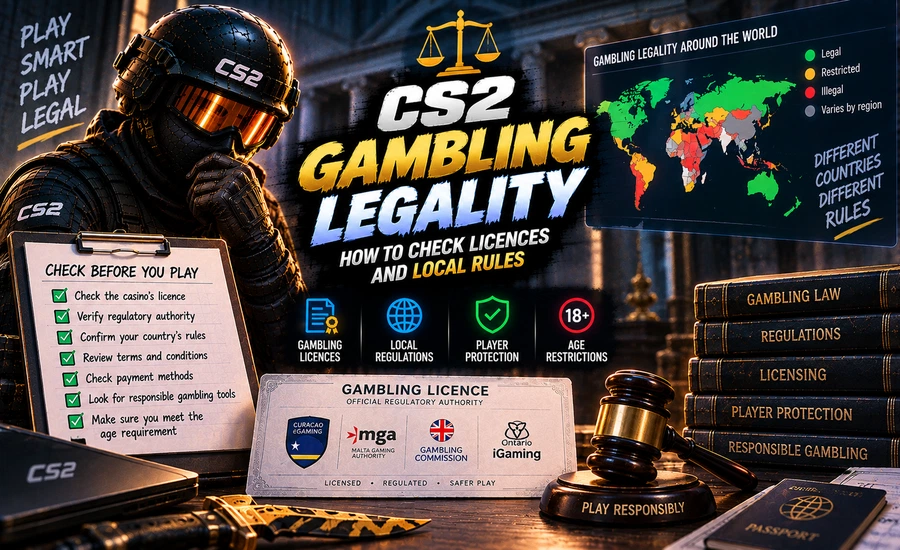
CS2 gambling legality depends on the jurisdiction, the game and the operator’s authorization. A site accepting skins or cryptocurrency does not establish that you may legally use it. A licence logo is a starting point for verification, not a worldwide permission slip. This guide shows how to check the relevant evidence without producing an unreliable country-by-country whitelist. The CSGO gambling pillar remains the platform overview.
CS2 gambling legality — 1. Start with your location and the actual activity
Write down where you are located when using the service, the product you intend to use and the value being risked. Betting on a CS2 match, entering a skin jackpot and buying a cosmetic item are different activities. Their legal treatment should not be inferred from a shared Counter-Strike logo.
A jurisdiction can distinguish sportsbook betting, casino games, prize promotions and trading. It can also have different rules for providing a service and participating in it. The site’s own restricted-country list is a contractual rule; it is not a complete explanation of local law.
This article provides a verification process and two sourced jurisdiction examples. It is not a personalized legal determination for every location or a recommendation to use any operator.
2. Identify the entity behind the brand
Read the current terms, footer and privacy or licence information. Record the company’s legal name, licence reference where claimed, exact domain and the product covered. A payment agent and the gambling operator can be different entities; record their roles rather than treating every company name as the licensee.
Do not rely on a promotional review to identify the entity. Brands can move between operators, use region-specific domains or change authorization. Match the current official record to the exact service you are considering.
For background, our existing Stake review and CSGOEmpire review describe platform features. Their presence on FlashyFlashy does not certify local permission, and current authorization must be checked independently.
3. Check the regulator’s record directly
Use the official regulator’s public register or published authorization list. Search for the legal entity or licence number and confirm whether the relevant activity and domain are covered. Read status information rather than stopping when you find a similar name.
The UK Gambling Commission provides a business register through its official site and explains how consumers can check account-opening information. Its operating-licence guidance says authorization is required to provide gambling facilities to consumers in Great Britain. That example applies to Great Britain; it is not a rule for every English-speaking country.
If a site links to a badge, independently verify the regulator’s domain and the underlying record. A copied image or a look-alike certificate page is not evidence of authorization.
4. Match the scope, not just the licence number
| Check | Evidence needed | What it does not prove by itself |
|---|---|---|
| Legal entity | Current terms matched to the regulator’s record | A similar brand name belongs to the same operator |
| Domain | Covered website or documented trading name | Every mirror or affiliate landing page is covered |
| Activity | Relevant gambling permission | A sportsbook permission also covers every casino game |
| Status | Current active authorization and conditions | An old certificate is still current |
| Location | Local law and operator eligibility | A foreign licence allows use everywhere |
| Player requirements | Applicable age, identity and account conditions | Successful registration establishes eligibility |
Keep a dated record of the checks. If you cannot establish a match, describe it as unverified rather than filling the gap with a favourable assumption.
5. Understand why skins can raise gambling questions
Digital items can have value and can be used as stakes or prizes. Calling the balance “coins” or the prize a “skin” does not settle its classification. The relevant authority’s definition and the product’s actual mechanics matter.
The UK Gambling Commission’s video-game and virtual-currency material raises concerns about unlicensed skin gambling and young people. Its position should be read in its jurisdictional context. Do not assume that every cosmetic purchase or every loot box has the same legal status as a cash-convertible skin wager.
For the broader risk discussion, read CS2 skin gambling. For Valve’s weapon-case probabilities, use case odds. Those articles answer different questions from whether a particular external service is authorized.
6. A Poland example: payment method does not override the framework
Poland’s Ministry of Finance explains that online gambling is generally within the state monopoly, with exceptions including mutual betting and promotional lotteries. It also explains the authorization requirement for online mutual betting and maintains official information about unlawful gambling domains.
These distinctions make a foreign casino licence or crypto deposit option insufficient evidence of permission in Poland. Consult the Ministry’s current guidance and the domain register, and seek qualified local advice where the classification of a particular skin product is unclear.
Absence from a blocked-domain list is not, on its own, positive authorization. Presence in an operator’s country selector is not positive authorization either. Use the relevant licence or statutory route for the actual activity.
7. Do not confuse access, fairness and permission
A website loading in your browser proves technical access. A correctly verified random result supports a limited fairness claim. A successful withdrawal shows one completed payment. None independently establishes legal eligibility for your location.
Our provably fair guide separates game-result verification from business authorization. Our Bitcoin payment guide separates transaction compatibility from the right to gamble. Keep those checks distinct when evaluating a service.
Do not use false account details or technical workarounds to bypass a country, age or identity restriction. They do not resolve the legal question and can create account and withdrawal problems.
8. Read consumer terms and complaint routes
Once authorization is established, read the current withdrawal, verification, bonus, account closure and complaint terms. Determine which entity is responsible for a dispute and which official escalation route applies, if any. A licence number does not mean every complaint will be resolved in your favor.
Record the order or bet ID, dates, account correspondence and terms relevant to the dispute. Send evidence through the authenticated support or official complaints process. Avoid private-message intermediaries who request a fee, login secret or another deposit to “release” money.
For legal or tax consequences specific to your circumstances, use qualified local advice. This guide does not supply a universal tax rate, assert that skins are exempt from reporting, or classify every game by its marketing name.
9. FlashyFlashy’s verification standard
Our editorial assessment is that a legality claim should state the jurisdiction, the entity, the activity and the official evidence. “Licensed” without that context is incomplete. “Safe everywhere” is not a defensible substitute for local checks.
Keep claims narrow. If you have verified a current record for one jurisdiction and one product, say exactly that. Do not extend it to another country, a mirror domain or a new game without checking. Review the claim when the entity, domain or rules change.
The existing CS2 betting guide covers match odds and markets. Understanding those mechanics is useful, but it does not replace the checks in this article.
Frequently asked questions
Is CS2 gambling legal everywhere?
No. The answer depends on the location, activity and operator’s authorization.
Does a foreign licence allow me to use a site anywhere?
No. A foreign authorization does not automatically satisfy your local rules.
How do I check a licence?
Identify the legal entity, domain and product, then match them to current official regulator records.
Is a licence badge enough?
No. Check the underlying record on the regulator’s genuine website.
Does paying with skins avoid gambling rules?
Do not assume that. Stakes, prizes and value can matter to legal classification.
Does cryptocurrency make gambling legal?
No. The payment method does not replace authorization or local eligibility.
Does provably fair mean legally licensed?
No. Result verification and authorization are separate checks.
What does the Poland example establish?
The Ministry describes a state-monopoly framework for online gambling with specified exceptions. Check the actual activity and current official rules.
Does an unblocked domain prove a site is authorized?
No. Technical access or absence from a blocked list is not positive authorization.
What should I do if I cannot verify eligibility?
Pause and obtain a reliable official or qualified local answer before depositing.
Related guides
- CSGO gambling overview
- CS2 skin gambling risks
- Provably fair explained
- Bitcoin payment checks
- CS2 match betting guide
- Responsible Gambling
Sources and methodology
- UK Gambling Commission: licence applications and scope
- UK Gambling Commission: opening accounts
- UK Gambling Commission: business register access
- UK Gambling Commission: video-game gambling concerns
- Polish Ministry of Finance: online gambling framework
- Polish Ministry of Finance: legal information and domain register
Reviewed October 2, 2026. Worked examples are educational calculations under the stated assumptions, not live odds, test-play results or promises of returns. Check the exact current rules and local eligibility.