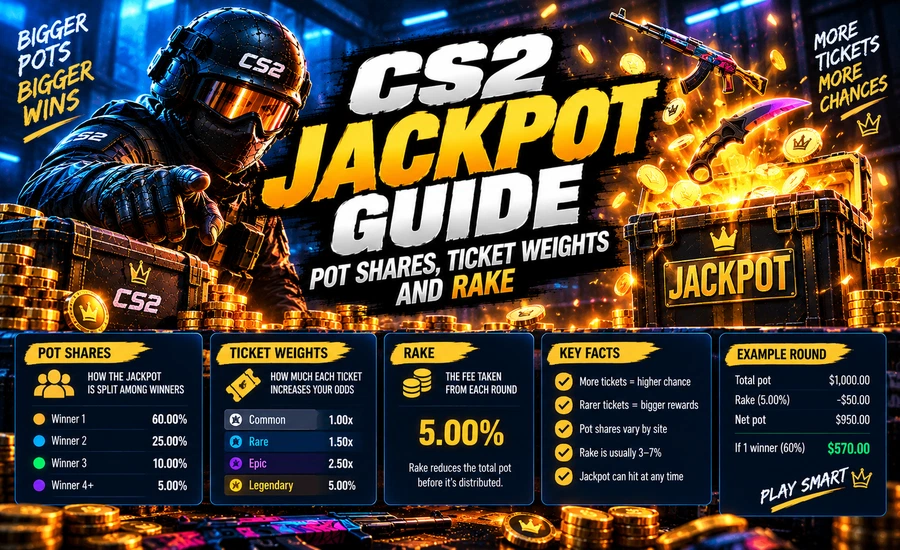
A CS2 jackpot pools skins or site credits from multiple players and awards the pot to one winner. In a proportional jackpot, your odds are your accepted contribution divided by the final pot. A $10 entry in a $100 pot has a 10% chance before any ticket rounding. This guide explains how to calculate CS2 jackpot odds, read ticket weights and account for rake. See the CSGO jackpot sites comparison for platform listings.
CS2 jackpot guide — 1. Identify the jackpot format
A pooled skin jackpot can collect items or balance contributions from several players and award a pot to one selected participant. A weighted version assigns chance according to each participant’s accepted contribution. An equal-ticket raffle, progressive prize or other game can use different mechanics.
Read whether tickets are proportional to value, fixed per entry or allocated by a separate schedule. Check whether the displayed chance is provisional while entries remain open. A large displayed prize does not establish what one entry’s probability is.
This article uses a proportional-weight pool for its calculations. Do not apply that model to another format merely because its name includes “Jackpot.” An equal-stake coinflip instead assigns the same chance to both players.
2. CS2 jackpot guide: calculate a contribution’s share
Let v be your accepted contribution and T the final total pot. If tickets are exactly proportional to value, your winning probability is v / T. A $10 contribution to a $100 final pot gives 10%. A $25 contribution to that same final pot gives 25%.
The denominator must include your contribution and all other accepted entries. If you add $10 to a pot already containing $90, the final total is $100. If you add $10 to a pot already containing $100, the total becomes $110 and your share is approximately 9.09%.
That distinction prevents a common calculation error. Use the final record and check whether rejected, refunded or late entries are included. A screenshot taken before the pot closes may not describe the settled probabilities.
3. Include rake in the payout
Suppose the final pot is $100, your contribution is $10, and an illustrative 5% fee is deducted from the entire pot. The winner receives $95 in the game’s unit. Your 10% chance produces expected gross proceeds of 0.10 × $95 = $9.50.
Subtracting the $10 contribution gives an expected net result of −$0.50, or a 5% loss relative to your stake. In this model the fee affects every proportional participant’s expected percentage result, even though their winning probabilities differ.
If the fee applies to a different basis, recalculate. A deduction from profit, a fixed fee or an item-specific payout charge is not identical to a percentage of the total pot.
4. CS2 jackpot guide: compare shares without confusing probability and value
| Final pot | Contribution | Winning share | Expected gross proceeds with 5% pot rake |
|---|---|---|---|
| $100 | $5 | 5% | $4.75 |
| $100 | $10 | 10% | $9.50 |
| $100 | $25 | 25% | $23.75 |
These rows describe separate positions within the same hypothetical final-pot model. A larger contribution wins more often but puts more value at risk. It does not turn the 5% modeled cost into an advantage.
A 90% chance can still lose. High probability should not be described as guaranteed, and increasing a contribution to recover a previous jackpot loss does not create certainty.
5. What late entries change
When another player adds value, the final pot grows and your percentage share falls, provided your own contribution is unchanged. The gross prize grows at the same time. Under the proportional model with a constant percentage rake, those effects offset in expected value: v / T × T × (1 − f) = v × (1 − f).
They do not offset in the experience of the round. You have a smaller chance of receiving a larger prize, which changes volatility. A late entry can also interact with minimums, caps, ticket rounding or format-specific conditions.
Read the rules rather than assuming the elegant proportional formula covers every exception. Save the final ticket ranges and accepted contributions if you want to audit the actual round.
6. CS2 jackpot guide: ticket allocation and rounding
A platform can represent probability using integer tickets. Check how many tickets each unit of value produces, how fractional amounts are rounded and whether a minimum entry affects allocation. A tiny entry can be treated differently if rounding is coarse.
Verify that ticket ranges cover the stated total without gaps, overlap or unexplained exclusions. The winning ticket needs to map to the same allocation recorded before settlement. A list of winners alone cannot establish that mapping.
If the allocation changes after entries close, obtain a documented explanation. A fairness proof should bind the final inputs and selection method, not only a random number detached from the pot record. See our verification guide.
7. Skin values and payout composition
The pot’s quoted value can differ from the net external resale value of its items. A low-liquidity craft or premium pattern may be priced in a way that does not match an executable cash offer. Check the valuation method and the timestamp used to accept contributions.
The payout can also be a platform balance or a selection of items rather than the exact contributed pool. Read how the fee is collected and how the winner’s assets are chosen. A displayed $95 prize is not automatically a $95 bank payout.
Use the trading workflow to verify assets. Compare quoted skin values with recent cash sales and check Steam trade restrictions before sending an item.
8. CS2 jackpot guide: waiting, reversals and disputes
Check what happens if a participant fails to deliver an item, a trade is reversed or the final pot does not meet the minimum. Terms should explain whether the round is cancelled, contributions refunded or the allocation adjusted. Do not assume an incomplete pot settles like a normal round.
Keep the round ID, contribution acceptance, final allocation, random result and payout record. If a discrepancy appears, contact official support with those records. Do not send another contribution as a supposed condition for releasing an existing prize.
Our existing CSGOEmpire review provides platform context. Verify actual mode availability and rules directly, together with the local authorization checks.
9. FlashyFlashy’s assessment and warning signs
Our editorial view is that jackpot transparency requires final pot values, exact weights, fee basis and payout composition. A large-prize screenshot omits most of that evidence. Claims that a particular seat, entry time or previous loss makes a win inevitable do not follow from the proportional model.
For another pooled comparison, review coinflip. Repeated selection games include Mines and Towers. Their probabilities are generated differently and should not be described using jackpot pot shares.
Frequently asked questions
How is jackpot chance calculated?
In a proportional-weight pool, divide your accepted contribution by the final accepted total pot.
Is every jackpot proportional to skin value?
No. Confirm the exact ticket and probability rules for the game.
Does the pot total include my contribution?
Yes in the stated model. Use the final total after your entry and all other accepted entries.
Does a larger stake improve expected percentage return?
Not in the constant-rake proportional model. It increases winning chance and value exposed.
What happens to my chance when another player joins?
Your percentage falls if your contribution stays fixed and the total pot grows.
Does that necessarily change expected value?
Not under the stated proportional model with constant percentage rake, although volatility changes.
Does a quoted $100 pot mean $100 cash?
Not necessarily. Valuation, payout composition and sale costs matter.
What is ticket rounding?
It is the conversion of contribution value into discrete tickets, which can affect small entries.
What should a fairness audit include?
Include final weights, ticket mapping, committed random selection and settled payout.
Can a high percentage share still lose?
Yes. Any chance below certainty includes a losing outcome.
Related guides
Sources and methodology
Reviewed October 2, 2026. Worked examples are educational calculations under the stated assumptions, not live odds, test-play results or promises of returns. Check the exact current rules and local eligibility.