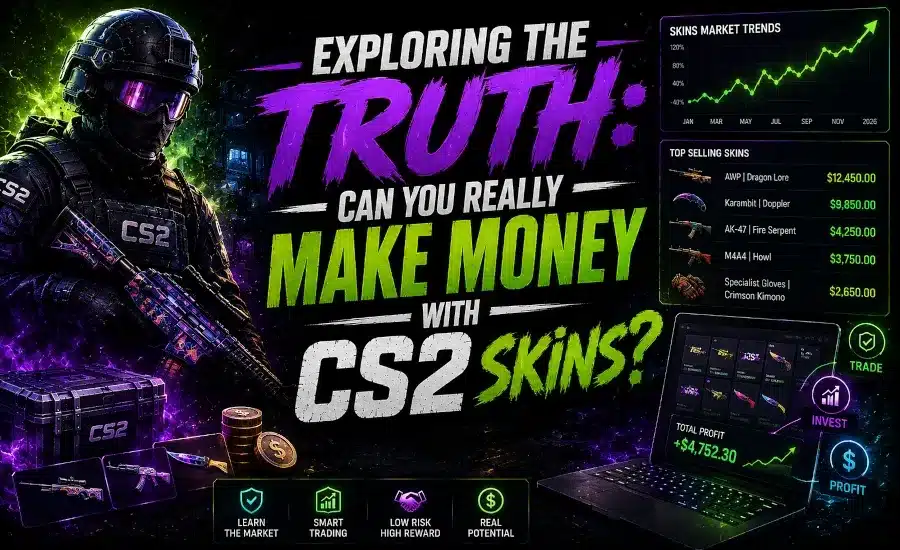
Yes, it is possible to make money with CS2 skins, but there is no guaranteed profit.
Players can potentially earn money through skin trading, buying undervalued items, long-term collecting, investing in discontinued collections, selling rare patterns, trading stickers, or using reputable CSGO trading sites.
However, the CS2 skin market behaves like any other collectible market. Prices can rise and fall, marketplace fees reduce profits, liquidity varies between items, and inexperienced traders can easily overpay.
The most successful traders usually rely on research, patience, market knowledge, and disciplined buying rather than luck.
Key Takeaways
✔ You can potentially make real money buying and selling CS2 skins.
✔ Skin prices are influenced by supply, demand, rarity, float value, Pattern ID, stickers, and collection availability.
✔ Buying undervalued skins and reselling them is one of the most common trading strategies.
✔ Rare discontinued collections can potentially increase in value over time.
✔ Steam Market prices do not necessarily represent the amount of cash you can withdraw.
✔ Marketplace fees must always be included when calculating profit.
✔ Rare patterns, low floats, and valuable sticker combinations may sell for significant premiums.
✔ CS2 cases should not be considered a reliable way to make money.
✔ No CS2 skin investment guarantees future returns.
✔ Understanding the market is far more important than simply buying expensive skins.
Can You Actually Make Real Money with CS2 Skins?
The enormous growth of the Counter-Strike skin economy has created an interesting question:
Can players actually make money from CS2 skins?
The answer is yes — but the reality is much more complicated than many videos, screenshots, and social media posts suggest.
Some players have successfully purchased skins for relatively low prices and later sold them for considerably more.
Others actively trade skins every week, searching for mispriced items and taking advantage of differences between marketplaces.
Collectors may hold rare items for years while waiting for demand to increase.
But there is another side of the market.
Players can also:
- buy at the top of the market,
- underestimate marketplace fees,
- purchase difficult-to-sell skins,
- overpay for stickers or patterns,
- lose money when demand falls,
- become victims of scams,
- speculate on items that never increase in value.
That means CS2 skins are not free money.
They are digital collectibles traded within a highly active marketplace.
Understanding that distinction is essential before attempting to make a profit.
Why Do CS2 Skins Have Real Value?
CS2 skins do not increase weapon damage.
They do not improve accuracy.
They do not give players competitive advantages.
Yet some skins are worth hundreds, thousands, or even considerably more.
Why?
Because their value is driven primarily by scarcity and demand.
The same principle exists in many traditional collectible markets.
Rare watches, trading cards, sneakers, artwork, and vintage items may command high prices because collectors want them while supply remains limited.
CS2 skins work in a similar way.
Their value can be influenced by:
- rarity,
- collection supply,
- case availability,
- float value,
- Pattern ID,
- StatTrak status,
- Souvenir status,
- stickers,
- professional player associations,
- visual appearance,
- popularity among players,
- broader market sentiment.
Understanding these factors is one of the foundations of successful CS2 skin trading.
The Main Ways Players Try to Make Money with CS2 Skins
There is no single strategy used by every trader.
Instead, the market contains several different approaches.
Some require substantial capital.
Others require significant research.
And some depend heavily on patience.
The most common strategies include:
- Buying undervalued skins
- Skin flipping
- Long-term investing
- Trading discontinued collections
- Rare pattern trading
- Float trading
- Sticker investing
- Case investing
- Cross-marketplace arbitrage
- Collector trading
Let’s examine each strategy individually.
1. Buying Undervalued CS2 Skins
One of the most straightforward methods is searching for items listed below their typical market value.
Imagine a skin normally trades for approximately $100.
A seller wants to liquidate their inventory quickly and lists it for $90.
A trader purchases the item and later resells it closer to the normal market price.
The difference appears to be profit.
However, there is an important detail:
fees.
If the marketplace charges transaction or withdrawal fees, a $10 price difference does not necessarily represent $10 of real profit.
Experienced traders therefore calculate:
Purchase Price + Fees + Selling Costs = Actual Cost
Only after accounting for those expenses can the potential margin be evaluated.
Example of a Simple CS2 Skin Trade
Imagine the following hypothetical transaction:
| Transaction | Amount |
|---|---|
| Skin Market Value | $120 |
| Purchase Price | $100 |
| Selling Price | $118 |
| Marketplace Fees | $7 |
| Approximate Profit | $11 |
The numbers look attractive.
But finding these opportunities consistently is difficult.
Competitive marketplaces often have thousands of traders searching for the same discounted items.
Speed and market knowledge therefore matter.
2. CS2 Skin Flipping
Skin flipping involves buying an item and attempting to sell it relatively quickly for a higher price.
Unlike long-term investing, the objective isn’t necessarily to hold the skin for months or years.
Instead, traders search for short-term pricing inefficiencies.
Potential opportunities include:
- incorrectly priced listings,
- temporary market drops,
- desirable floats listed at ordinary prices,
- valuable stickers ignored by sellers,
- unusual Pattern IDs,
- price differences between marketplaces.
Successful flipping requires detailed knowledge of market prices.
A trader must recognize a good deal almost immediately.
Otherwise, another buyer will probably purchase it first.
Is Skin Flipping Easy?
No.
The basic idea is simple.
Executing it consistently is much harder.
Competition is extremely high.
Professional traders, automated tools, price trackers, and experienced collectors constantly monitor marketplace listings.
Beginners often make the mistake of believing that any discounted skin represents an opportunity.
But a skin may be discounted because:
- demand is falling,
- liquidity is poor,
- other marketplaces offer it cheaper,
- the reference price is outdated,
- the skin has undesirable characteristics.
A low price alone does not automatically mean an item is undervalued.
3. Long-Term CS2 Skin Investing
Another popular strategy involves purchasing skins and holding them for long periods.
Instead of trying to make $5 or $10 from a quick trade, investors hope that limited supply and increasing demand will gradually push prices higher.
Items frequently considered by long-term collectors include:
- discontinued collections,
- operation skins,
- rare knives,
- limited stickers,
- older cases,
- desirable gloves,
- historically significant items.
The logic is straightforward.
If supply becomes increasingly limited while demand remains strong, prices may rise.
However, there is no guarantee that demand will continue increasing.
Why Discontinued Collections Attract Investors
CS2 skin supply is extremely important.
Some skins can continue entering circulation because their cases remain available.
Other skins originate from collections or operations that are no longer actively distributed.
When new supply becomes limited, existing items become increasingly important.
If demand remains strong, scarcity can potentially support higher prices.
This is one reason collectors closely monitor discontinued collections.
4. Rare Pattern Trading
Some CS2 skins contain Pattern IDs that make certain examples considerably more desirable than ordinary versions.
This creates an advanced niche within the skin economy.
Popular pattern categories include:
- Case Hardened Blue Gems,
- Fade percentages,
- Doppler phases,
- Sapphire,
- Ruby,
- Emerald,
- Fire & Ice Marble Fade patterns.
Two skins may technically share the same name and exterior condition while selling for dramatically different prices because of their patterns.
This creates opportunities for knowledgeable traders.
But it also creates substantial risk for beginners.
Determining the correct premium can be difficult.
Pattern Knowledge Can Create an Advantage
Consider two Case Hardened knives.
Both may have:
- the same knife model,
- the same exterior condition,
- similar float values.
However, one may contain an ordinary pattern while the other displays an exceptionally blue play side.
The second item may command a substantial collector premium.
An inexperienced seller might list both according to ordinary marketplace prices.
A knowledgeable trader could potentially identify the valuable pattern.
This is one of the clearest examples of how information can create an advantage within the CS2 market.
5. Float Trading
Every CS2 skin has a Float Value that helps determine its wear.
Typical exterior categories include:
| Exterior | Float Range |
|---|---|
| Factory New | 0.00–0.07 |
| Minimal Wear | 0.07–0.15 |
| Field-Tested | 0.15–0.38 |
| Well-Worn | 0.38–0.45 |
| Battle-Scarred | 0.45–1.00 |
However, collectors often care about much more than the basic exterior category.
For example:
A Factory New skin with a float of 0.069 and one with a float of 0.002 belong to the same exterior category.
But collectors may value them very differently.
Extremely low floats can command premiums.
So can unusually high floats on certain collectible skins.
Why Low Floats Can Be Valuable
Collectors sometimes search specifically for:
- 0.00x floats,
- 0.000x floats,
- top-ranking float values,
- lowest known examples,
- unusually clean finishes.
The rarer the float, the more specialized the buyer pool becomes.
This can create substantial premiums.
It can also create another problem:
liquidity.
A rare float may theoretically be worth much more than an ordinary example, but finding a buyer willing to pay that premium may take considerably longer.
6. Sticker Trading and Sticker Crafts
Stickers created another major collector market inside Counter-Strike.
Rare examples include:
- Katowice 2014 stickers,
- tournament Gold stickers,
- valuable autograph stickers,
- discontinued capsules,
- desirable Foil and Holo designs.
Some unused stickers can be traded individually.
Others derive value from being applied to historically important skins.
Applied Stickers Are More Complicated
Suppose a skin contains $2,000 worth of stickers.
That does not automatically mean the skin is worth:
Base skin price + $2,000
Applied stickers usually lose part of their standalone market value.
The premium depends on factors such as:
- sticker rarity,
- sticker position,
- number of matching stickers,
- skin compatibility,
- overall appearance,
- collector demand.
Certain crafts can command exceptional premiums.
Others may add surprisingly little value.
This makes sticker trading one of the more advanced CS2 trading niches.
7. Investing in CS2 Cases
Some traders purchase older CS2 cases rather than individual weapon skins.
The investment theory is based largely on supply.
When cases stop dropping frequently, existing supplies may gradually decline because players continue opening them.
If demand remains strong, prices can potentially increase.
Historically, this has made certain older cases attractive to collectors and speculators.
But again:
past price increases do not guarantee future results.
Valve controls major parts of the CS2 economy.
Changes to:
- drop systems,
- case availability,
- game mechanics,
- trade restrictions,
- marketplace rules
can influence prices.
Opening Cases Is Different from Investing in Cases
This distinction is extremely important.
Buying and holding a case is an investment strategy.
Opening a case is essentially paying for a randomized outcome.
The expected value of opening cases is generally not something players should treat as a consistent income strategy.
You may receive a valuable knife.
You may also open dozens of cases and receive mostly inexpensive skins.
Therefore:
Case opening should be considered entertainment, not a reliable way to generate profit.
8. Cross-Marketplace Arbitrage
CS2 skins can trade at different prices across different marketplaces.
This creates another strategy:
arbitrage.
The basic idea is to buy a skin where it is cheaper and sell it somewhere it is more expensive.
For example:
| Marketplace | Skin Price |
|---|---|
| Marketplace A | $95 |
| Marketplace B | $103 |
| Difference | $8 |
At first glance, the $8 difference looks like easy profit.
But traders must account for:
- buyer fees,
- seller fees,
- withdrawal fees,
- deposit fees,
- currency conversion,
- trade restrictions,
- price volatility.
After accounting for every cost, the actual margin may be significantly smaller.
9. Trading Collector Items
Some of the largest potential premiums exist outside normal marketplace pricing.
Collector items can include:
- Blue Gems,
- rare sticker crafts,
- extremely low floats,
- Souvenir skins,
- discontinued skins,
- rare knives,
- unusual Pattern IDs,
- historically significant inventories.
These items often cannot be valued accurately using only ordinary marketplace averages.
Instead, traders may research previous sales and communicate directly with specialist collectors.
Collector Value vs Market Value
This distinction is essential.
Market value represents the amount an ordinary skin frequently sells for.
Collector value represents the premium a specialized buyer may pay for exceptional characteristics.
For example:
A normal Case Hardened skin might sell for one price.
A rare Blue Gem version of exactly the same skin could be worth considerably more.
Understanding the difference is one of the skills separating experienced collectors from casual traders.
How Much Money Can You Make with CS2 Skins?
There is no reliable answer.
Some traders may make small profits from occasional trades.
Experienced traders handling larger inventories may potentially generate significantly more.
Others lose money.
Results depend on:
- starting capital,
- experience,
- market knowledge,
- trading frequency,
- strategy,
- marketplace fees,
- risk tolerance,
- market conditions.
Someone starting with a $50 inventory should not expect the same absolute returns as someone trading thousands of dollars worth of collector items.
Percentage Returns Matter More Than Screenshots
Suppose Trader A earns $100 from a $10,000 inventory.
Trader B earns $50 from a $500 inventory.
Trader A made more dollars.
But Trader B generated a significantly higher percentage return.
This is why profit screenshots can be misleading.
Without knowing:
- purchase price,
- total capital,
- fees,
- time held,
- failed trades,
it is impossible to properly evaluate performance.
The Difference Between Steam Value and Real Cash Value
One of the most common mistakes among beginners is assuming:
Steam Market price = cash value
This is not necessarily true.
Money stored in the Steam Wallet generally remains within the Steam ecosystem.
Third-party skin marketplaces may allow users to sell eligible skins for withdrawable funds.
However, cash marketplace prices are often different from Steam prices.
Therefore, a skin displaying a $500 Steam valuation may not necessarily produce $500 in withdrawable cash.
This difference should always be considered when calculating inventory value.
Marketplace Fees Can Destroy Small Profits
Imagine purchasing a skin for $100 and selling it for $105.
You appear to have made 5%.
But if combined fees equal 7%, the trade actually generated a loss.
Before buying any item, experienced traders ask:
What is my realistic selling price after fees?
Not:
What is the highest listing price currently visible?
This small distinction can dramatically improve trading discipline.
Liquidity: The Factor Beginners Often Ignore
Imagine owning a theoretically valuable skin worth $5,000.
That’s excellent — assuming someone wants to buy it.
Liquidity describes how easily an asset can be sold near its expected market price.
Popular skins may have strong liquidity.
Extremely specialized collector items can take much longer to sell.
A skin might theoretically be worth $10,000 but require weeks or months to find the right buyer.
That makes liquidity extremely important when building a trading inventory.
High-Liquidity CS2 Items
Generally, frequently traded and recognizable skins tend to be easier to sell.
Examples can include popular finishes for:
- AK-47,
- AWP,
- M4A1-S,
- M4A4,
- Desert Eagle,
- USP-S,
- Glock-18,
- popular knife models.
Collector items may offer larger potential margins but often require more patience.
Is CS2 Gambling Skin Trading?
Not necessarily.
Traditional skin trading involves buying or exchanging items based on agreed prices.
The outcome does not inherently depend on a random game result.
However, CS2 gambling is different.
Activities such as:
- roulette,
- coinflip,
- crash,
- case battles,
- jackpot,
- randomized case opening
involve chance.
They should therefore not be confused with ordinary marketplace trading.
If the objective is consistent market-based trading, relying on CS2 gambling results is not a sustainable strategy.
Can You Make Money from CS2 Gambling?
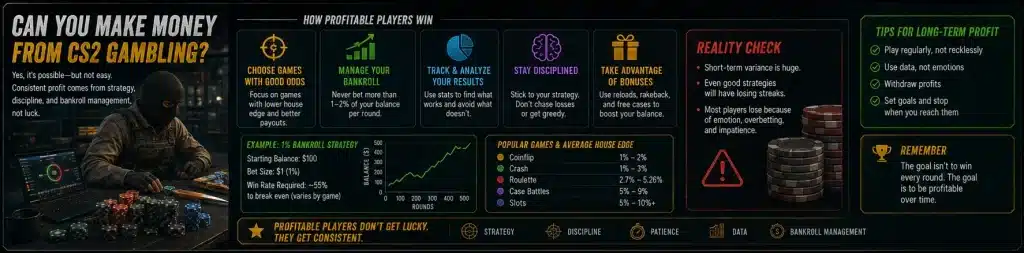
Individual players can obviously win individual bets or receive valuable items.
That does not make CS2 gambling a dependable source of income.
Casino-style games are fundamentally different from trading.
Trading involves evaluating the value of an asset and attempting to buy or sell it at an advantageous price.
CS2 Gambling depends largely or entirely on uncertain outcomes.
Players interested in CS2 gambling websites should treat them as entertainment rather than investment vehicles.
You can compare platforms, bonuses, games, and safety features in our:
Can Beginners Make Money Trading CS2 Skins?
Potentially. So, how to make money on CS2 and how to make profit in CS2?
But beginners should start small.
The objective should initially be learning rather than maximizing returns.
New traders should understand:
- Steam pricing,
- cash pricing,
- marketplace fees,
- float values,
- Pattern IDs,
- collection rarity,
- liquidity,
- trade restrictions,
- money playing cs2,
- API scam risks.
Making small mistakes with inexpensive skins is considerably less painful than learning the same lessons with a multi-thousand-dollar knife.
Expert Tip – Cs2 how to make money?
Do not buy a skin simply because someone claims it is an “investment.”
Before purchasing, ask:
- Why should demand increase?
- Is supply limited?
- How many listings exist?
- How often does the item actually sell?
- What are recent realistic sale prices?
- What marketplace fees will I pay?
- How quickly could I liquidate the item?
- What could cause the price to fall?
If you cannot answer those questions, you probably do not understand the trade well enough yet.
Common Mistakes That Cause CS2 Traders to Lose Money
Many losses are caused by avoidable mistakes rather than unpredictable market crashes.
Common examples include:
Buying During Hype
When a skin suddenly becomes popular, inexperienced buyers may rush into the market.
The price rises quickly.
Eventually, demand cools.
Late buyers can become stuck holding an item purchased near its peak.
Ignoring Fees
Small margins disappear quickly when transaction costs are included.
Trusting Listing Prices
Someone can list a skin for almost any amount.
A listing does not represent a completed sale.
Actual historical transactions provide much stronger evidence of market value.
Buying Illiquid Items
An item can appear valuable but be extremely difficult to sell.
Overpaying for Stickers
Sticker premiums require specialist knowledge.
Assuming Prices Only Go Up
They don’t.
CS2 skins can decline in value.
Using Untrusted Platforms
Scams remain one of the largest risks within virtual item trading.
CS2 Skin Scams Can Erase Years of Profit
A trader can spend years building an inventory and lose it extremely quickly through a phishing or API scam.
Common threats include:
- fake Steam login pages,
- impersonated traders,
- fraudulent marketplace websites,
- fake middlemen,
- phishing advertisements,
- malicious browser extensions,
- fake trade bots.
Always verify domains carefully and confirm trade details before accepting transactions.
Security should be considered part of investment performance.
A 20% annual gain means little if the entire inventory is later stolen.
What Makes a Good CS2 Skin Investment?
No item is guaranteed to increase in value.
However, collectors frequently evaluate several characteristics.
| Factor | Why It Matters |
|---|---|
| Limited Supply | Scarcity may support prices |
| Strong Demand | More potential buyers |
| Popular Weapon | Larger player audience |
| Rare Pattern | Collector premium |
| Low Float | Increased rarity |
| Discontinued Collection | Reduced new supply |
| Historical Significance | Collector interest |
| Valuable Stickers | Potential additional premium |
| Strong Liquidity | Easier resale |
The strongest collectible items often combine several of these factors.
Should You Buy Cheap or Expensive Skins?
Neither category automatically produces better returns.
Cheap skins have several advantages:
- lower entry cost,
- easier diversification,
- lower financial risk per item.
Expensive skins may provide:
- stronger collector demand,
- greater rarity,
- access to specialist markets.
However, expensive items also expose traders to larger absolute losses.
A balanced inventory can potentially reduce dependence on a single item.
Diversification in CS2 Skin Investing
Imagine investing an entire budget into one knife.
If demand for that exact knife falls sharply, the entire portfolio suffers.
Another trader might divide capital across:
- skins,
- cases,
- stickers,
- discontinued collections,
- liquid playskins.
Diversification does not eliminate risk.
But it can reduce dependence on one specific item.
Can CS2 Skins Be a Full-Time Income?
For most players, this is unrealistic.
Professional trading requires:
- significant capital,
- extensive market experience,
- strong marketplace relationships,
- constant research,
- inventory management,
- risk management,
- tax and regulatory awareness.
Someone occasionally flipping a few skins should not expect to immediately generate a stable salary.
The CS2 economy can provide opportunities, but it should not be confused with guaranteed employment.
Are CS2 Skins a Better Investment Than Traditional Assets?
They are fundamentally different.
Stocks may represent ownership in companies.
Bonds represent debt.
Real estate represents physical property.
CS2 skins are digital collectibles whose value depends heavily on:
- player demand,
- scarcity,
- Counter-Strike’s popularity,
- Valve’s ecosystem,
- trading infrastructure.
Therefore, they generally carry a different and potentially much higher risk profile than conventional investments.
CS2 skins should primarily be viewed as collectibles with a tradable market, not substitutes for diversified traditional investments.
When Is the Best Time to Buy CS2 Skins?
There is no universally perfect time.
Experienced traders may look for opportunities during:
- broad market corrections,
- temporary sell-offs,
- major content releases,
- tournament periods,
- operation announcements,
- changes in case supply.
The key is avoiding emotional decisions.
Buying simply because prices are rising can be dangerous.
Sometimes the best trade is doing nothing.
When Should You Sell?
Selling decisions can be just as difficult as buying decisions.
Potential reasons include:
- the original investment thesis has changed,
- demand has weakened,
- better opportunities exist,
- the item has reached a target price,
- liquidity is declining,
- portfolio concentration has become excessive.
Some traders also sell gradually rather than attempting to identify the exact market peak.
No one consistently buys at the exact bottom and sells at the exact top.
Expert Strategy: Think Like a Collector and a Trader
One of the strongest advantages in CS2 trading comes from understanding why another person would want the item.
Instead of asking only:
Will this price increase?
Ask:
Who will eventually buy this from me, and why?
A rare float may appeal to float collectors.
A Blue Gem may appeal to Pattern ID collectors.
A four-sticker craft may appeal to sticker collectors.
A discontinued skin may appeal to long-term investors.
A popular AK-47 finish may appeal to thousands of ordinary players.
Understanding the future buyer is an essential part of understanding market demand.
So, Can You Really Make Money with CS2 Skins?
Yes.
But it is not as easy as:
Buy skin → wait → become rich.
Successful trading generally requires:
- research,
- patience,
- accurate pricing,
- understanding fees,
- risk management,
- strong security,
- knowledge of collector preferences.
The CS2 skin economy provides legitimate trading opportunities because millions of players value these digital collectibles.
At the same time, every potential profit exists alongside potential loss.
That makes education one of the most valuable investments a new trader can make.
Frequently Asked Questions
Can you make real money from CS2 skins?
Yes.
Players can potentially make money by buying skins at favorable prices and reselling them through marketplaces that support cash withdrawals.
However, profit is never guaranteed.
Marketplace fees, price volatility, liquidity, and poor buying decisions can all result in losses.
What is the easiest way to make money with CS2 skins?
There is no guaranteed easy method.
For beginners, learning how to identify realistically priced, liquid skins is generally safer than immediately speculating on rare patterns or expensive sticker crafts.
Is CS2 skin trading profitable?
It can be profitable for knowledgeable traders.
However, results vary widely and many players lose money.
Successful trading requires understanding pricing, supply, demand, liquidity, and marketplace fees.
Are CS2 skins a good investment?
Some skins have increased substantially in value over time.
That does not guarantee future returns.
CS2 skins are best viewed as digital collectibles whose prices are determined by market demand and scarcity.
Can you make money opening CS2 cases?
Individual players can receive valuable items from cases.
However, randomized case opening should not be treated as a reliable income strategy.
Opening cases is fundamentally different from market-based skin trading.
What CS2 skins increase in value?
No specific skin is guaranteed to appreciate.
Collectors often monitor skins with characteristics such as limited supply, discontinued collections, strong demand, rare patterns, exceptional float values, or historical significance.
Can you sell CS2 skins for real cash?
Certain third-party CS2 skin marketplaces allow eligible users to sell skins and withdraw funds using supported payment methods.
Steam Community Market funds remain within the Steam ecosystem rather than functioning like a standard cash withdrawal service.
How much money do I need to start CS2 skin trading?
There is no required amount.
Beginners can start with inexpensive skins while learning market mechanics.
Starting small also reduces the financial impact of early mistakes.
What is CS2 skin flipping?
Skin flipping involves buying an item at one price and attempting to resell it relatively quickly for a higher price.
Successful traders must account for transaction fees and realistic selling prices before buying.
Are rare Pattern IDs profitable?
Rare patterns can command significant collector premiums.
However, Pattern ID trading requires specialist knowledge, and rare items may be less liquid than ordinary skins.
Read our CS2 Skin Patterns Explained guide before entering this market.
What is the biggest risk when trading CS2 skins?
Price declines are an obvious risk, but scams can be even more damaging.
Fake Steam login pages, fraudulent trade bots, phishing links, and impersonated traders can result in complete inventory loss.
Should I use Steam or third-party marketplaces?
Steam provides a convenient marketplace within the Steam ecosystem.
Third-party CSGO trading sites may offer different pricing, fees, trading tools, and withdrawal options.
Always research a marketplace carefully before depositing or trading valuable items.
Final Thoughts
Making money with CS2 skins is possible, but the skin economy should not be mistaken for a guaranteed profit machine.
The traders most likely to succeed are not necessarily those with the most expensive inventories.
They are often those who understand the market best.
They research supply.
They monitor demand.
They understand floats and Pattern IDs.
They calculate marketplace fees.
They recognize collector premiums.
Most importantly, they know when not to buy.
The CS2 skin market has evolved into an extraordinarily sophisticated digital collectible economy, with ordinary players, collectors, traders, and investors participating worldwide.
That creates opportunities.
But opportunities always come with risk.
If you want to explore the market further, start with our complete guides below.