Quick Answer
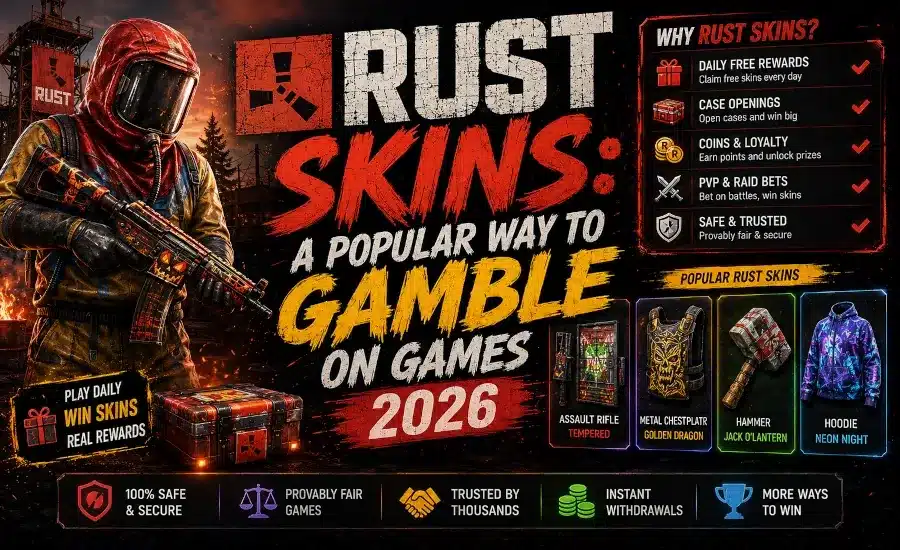
Rust skins are cosmetic items that allow players to customize weapons, clothing, tools, doors, armor, and other equipment in Rust.
Over time, these digital items have developed their own trading economy. Some Rust skins can be bought and sold through Steam and third-party marketplaces, while certain gambling platforms also allow players to deposit skins or their equivalent value to play games such as Crash, Roulette, Coinflip, Jackpot, Case Battles, and Mines.
However, Rust skin gambling involves real financial risk.
There is no guaranteed way to make money gambling with Rust skins, and players should never assume that valuable skins or betting strategies will produce predictable profits.
If you are interested in Rust gambling in 2026, understanding skin values, marketplace pricing, casino mechanics, fees, security, and responsible gambling is essential.
Key Takeaways
✔ Rust skins are cosmetic digital items used throughout Rust.
✔ Many Rust skins can be traded through Steam and third-party marketplaces.
✔ Scarcity, popularity, design, availability, and demand can influence skin prices.
✔ Some Rust gambling sites allow players to use skin value to participate in casino-style games.
✔ Popular Rust gambling formats include Crash, Coinflip, Roulette, Jackpot, Mines, and Case Battles.
✔ Skin gambling is not a reliable way to make money.
✔ Marketplace price and real cash value may be different.
✔ Never deposit valuable skins without checking the platform first.
✔ Steam impersonation, fake bots, phishing websites, and fraudulent trades remain important security risks.
✔ Players should only gamble amounts they can afford to lose.
What Are Rust Skins?
Rust skins are cosmetic items that change the appearance of equipment in Rust, the multiplayer survival game developed by Facepunch Studios.
They do not generally provide a direct competitive advantage.
Instead, skins allow players to personalize their equipment.
Rust cosmetic items can cover many categories, including:
- weapons,
- armor,
- clothing,
- doors,
- storage boxes,
- tools,
- sleeping bags,
- furnaces,
- deployable objects.
For many players, skins are simply a way to make their character or base look more distinctive.
For others, they have become collectible digital assets.
Why Are Rust Skins So Popular?
Rust combines survival gameplay with a strong player-driven community.
Players spend significant amounts of time:
- building bases,
- raiding opponents,
- collecting resources,
- crafting weapons,
- competing with other players.
Cosmetic customization allows players to add personality to items they use repeatedly.
Rare or recognizable skins can also become status symbols.
Over time, this created demand for:
- collecting skins,
- buying skins,
- selling skins,
- trading skins,
- building themed inventories.
This secondary economy is one reason Rust skins became interesting beyond the game itself.
Do Rust Skins Have Real Value?
Some Rust skins have market value because players are willing to buy and sell them.
Their prices can be influenced by several factors.
| Factor | Why It Matters |
|---|---|
| Supply | Limited supply can increase scarcity |
| Demand | Popular skins attract more buyers |
| Design | Attractive designs may receive stronger demand |
| Availability | Discontinued items can become harder to obtain |
| Weapon Popularity | Skins for frequently used items may attract more players |
| Market Sentiment | Prices can rise or fall with community interest |
| Historical Significance | Older or iconic items may develop collector interest |
However:
market value is not guaranteed.
A skin worth $100 today could theoretically become more valuable.
It could also fall considerably in price.
Where Do Rust Skins Come From?
Players can obtain Rust skins in several ways.
These can include:
- purchasing items through Steam,
- buying skins from other marketplaces where available,
- receiving items through game-related systems,
- trading with other users,
- purchasing limited or rotating cosmetic items.
Availability changes over time.
This is important because reduced supply can sometimes affect collector demand.
Buying Rust Skins on Steam
Steam provides one of the most familiar ways for players to trade eligible Rust cosmetic items.
The Steam Community Market allows users to:
- browse available skins,
- review listed prices,
- purchase eligible items,
- list their own items for sale.
Steam provides a convenient ecosystem because items remain connected to the player’s Steam inventory.
However, money received through Steam Market transactions becomes Steam Wallet balance.
This is different from withdrawing ordinary cash directly to a bank account.
Steam Value vs Cash Value
This distinction is extremely important for anyone interested in skin trading or gambling.
Imagine a Rust skin is listed on Steam for:
$100
That does not necessarily mean it is worth $100 in withdrawable cash.
Third-party marketplace prices can be lower.
For example:
| Pricing Type | Hypothetical Value |
|---|---|
| Steam Market Price | $100 |
| Third-Party Listing | $85 |
| Quick-Sell Value | $78 |
| Amount After Fees | $74 |
These are only illustrative numbers.
The important lesson is:
Steam price does not automatically equal cash value.
Always consider fees and realistic sale prices.
What Is Rust Skin Gambling?
Rust skin gambling refers to gambling activities connected with Rust cosmetic items or their value.
Historically, some platforms allowed players to deposit skins directly.
Modern sites may use different systems.
A player might:
- deposit supported items or funds,
- receive a balance,
- use that balance to play casino-style games,
- win or lose depending on the outcome,
- withdraw supported items or funds where available.
Specific systems vary between websites.
Always review how deposits, withdrawals, and balances work before using any platform.
Is Rust Skin Gambling the Same as Trading?
No.
This distinction is very important.
Rust Skin Trading
Trading generally involves:
buying or selling an item at an agreed price.
For example:
Buy skin for $50 → sell skin for $60.
The result depends largely on:
- market value,
- supply,
- demand,
- fees,
- timing.
Rust Skin Gambling
Gambling involves uncertain outcomes.
For example:
Deposit $50 → wager $10 on Coinflip → win or lose according to the game’s result.
The player does not know the outcome beforehand.
That means gambling creates fundamentally different risk from ordinary skin trading.
Popular Types of Rust Skin Gambling
Rust gambling platforms have used several game formats.
The exact games depend on the individual site.
Common categories include:
- Crash
- Coinflip
- Roulette
- Jackpot
- Mines
- Case Opening
- Case Battles
- Upgrade games
Let’s examine how they work.
1. Rust Crash Gambling
Crash is one of the most recognizable online gambling games.
A multiplier starts increasing:
1.01x → 1.20x → 1.50x → 2x → 5x → 10x…
At an unpredictable point, the round crashes.
Players attempt to cash out before that happens.
Example:
You wager:
$10
You cash out at:
2.00x
Potential payout:
$20
But if the game crashes before you cash out, you lose the wager.
Can You Predict Rust Crash?
No strategy can reliably predict independent randomized outcomes.
Players sometimes analyze previous multipliers searching for patterns.
For example:
1.20x
1.04x
8.72x
2.13x
1.01x
But previous results do not necessarily predict the next round.
This is similar to the gambler’s fallacy seen in traditional casino games.
2. Rust Coinflip
Coinflip is one of the simplest skin gambling formats.
Two players contribute value to a wager.
One side wins the pot according to the game’s result.
Example:
Player A:
$50
Player B:
$50
Total pot:
$100
The winner receives the pot minus any applicable platform fee.
Coinflip is attractive because it is easy to understand.
But the result remains uncertain.
Repeatedly doubling your wagers after losses does not guarantee recovery.
3. Rust Roulette
Rust-themed roulette usually follows the basic idea of traditional roulette or simplified color-based casino games.
Players may wager on options such as:
- red,
- black,
- green,
- numbers,
- other platform-specific outcomes.
Different outcomes can have different payouts.
A larger potential payout normally corresponds with a lower probability of winning.
Can You Beat Rust Roulette?
There is no guaranteed roulette strategy.
Systems such as:
- Martingale,
- Fibonacci,
- D’Alembert,
change bet sizes.
They do not change the underlying probability of the game.
Suppose you use Martingale:
$5
$10
$20
$40
$80
$160
$320
After only several losses, the required wager becomes very large.
Eventually, players encounter:
- limited bankroll,
- casino limits,
- substantial financial exposure.
4. Rust Jackpot
Jackpot games usually involve multiple players contributing items or value into one combined pot.
Your probability of winning may depend on how much you contribute.
Hypothetical example:
| Player | Contribution |
|---|---|
| Player A | $10 |
| Player B | $20 |
| Player C | $30 |
| Player D | $40 |
| Total | $100 |
Player D might theoretically receive approximately 40% of the entries or winning probability, depending on the site’s rules.
But Player D can still lose.
A higher contribution does not guarantee victory.
5. Rust Mines
Mines games typically display a grid of hidden tiles.
Some contain safe outcomes.
Others contain mines.
Players select tiles one at a time.
Each safe selection generally increases the potential payout.
The player can:
- continue,
- cash out,
- risk revealing another tile.
More mines usually means:
- greater risk,
- larger potential multipliers.
Should You Keep Playing Mines After a Win?
There is no universal answer.
Continuing increases potential reward.
But it also exposes the existing winnings to another uncertain outcome.
This illustrates a fundamental gambling tradeoff:
more potential reward usually requires more risk.
6. Rust Case Opening
Some gambling websites use virtual case-opening systems inspired by game item cases.
Players purchase or open a case containing several possible outcomes.
For example:
| Item | Hypothetical Probability |
|---|---|
| Common Skin | 60% |
| Better Skin | 25% |
| Rare Skin | 10% |
| Premium Skin | 4% |
| Jackpot Skin | 1% |
Actual odds depend on the platform.
Players should check whether probabilities are clearly displayed.
Is Rust Case Opening Profitable?
An individual case can produce a valuable outcome.
That does not make repeated case opening a reliable method of generating profit.
If the expected value of the potential outcomes is lower than the price of opening the case, the platform retains a mathematical advantage over time.
Therefore:
Case opening should be treated as gambling entertainment rather than an investment strategy.
7. Rust Case Battles
Case Battles add a competitive element to case opening.
Two or more players may open the same group of cases.
Depending on the game mode, the player whose items have the highest combined value may win the pot.
The format can feel more strategic because players compete against each other.
But the contents of the cases remain uncertain.
That makes Case Battles another gambling format.
8. Rust Skin Upgrader
Upgrade games usually allow players to risk a lower-value item for the chance to receive something more valuable.
Example:
Current item:
$20
Target skin:
$100
The site calculates a probability of success.
If the upgrade succeeds:
you receive the higher-value item.
If it fails:
you may lose your original item.
Higher upgrades normally require lower probabilities.
Can You Make Money Gambling With Rust Skins?
You can win individual games.
You can also finish individual gambling sessions with more value than you started with.
But this should not be confused with guaranteed long-term profit.
Casino-style gambling normally includes a mathematical advantage for the operator.
That means Rust gambling should not be treated as a reliable source of income.
Trading vs Gambling: Which Has More Control?
Trading and gambling require very different approaches.
| Rust Skin Trading | Rust Skin Gambling |
|---|---|
| Based on market prices | Based on uncertain outcomes |
| Research can affect decisions | Outcomes include randomness |
| You decide purchase price | Casino rules determine payouts |
| Items can be held long term | Bets resolve quickly |
| Supply and demand matter | Probability and house edge matter |
| Profit is still not guaranteed | Profit is still not guaranteed |
Trading may allow players to make more informed market decisions.
But trading also includes risk.
Skin values can fall.
Can Rust Skins Be Investments?
Some players collect Rust skins hoping they will increase in value.
The basic theory is similar to other collectible markets.
Imagine a limited skin.
Supply gradually becomes restricted.
Demand remains strong.
Collectors continue competing for the available items.
The price may increase.
But several things can also happen:
- demand falls,
- player preferences change,
- similar cosmetics appear,
- market liquidity decreases,
- Rust popularity changes.
Therefore, Rust skins should primarily be considered digital collectibles rather than guaranteed investments.
What Makes a Rust Skin Valuable?
Several characteristics can potentially influence price.
Scarcity
Limited supply can increase collector interest.
Popularity
A visually attractive skin for a frequently used weapon may attract more buyers.
Age
Older cosmetics can develop collector appeal.
Availability
Items that are difficult to obtain may become more desirable.
Weapon or Item Type
Skins attached to popular weapons or frequently used items can attract stronger demand.
Community Recognition
Some skins become iconic because they are widely recognized by Rust players.
Expensive Rust Skins vs Cheap Rust Skins
Expensive skins are not automatically better investments.
Cheap skins are not automatically better opportunities.
Players should evaluate:
- supply,
- demand,
- historical pricing,
- liquidity,
- popularity.
A $5 skin can theoretically double to $10.
A $500 skin can also theoretically fall to $300.
Absolute price alone tells you very little about future performance.
How To Check Rust Skin Prices
Before trading or depositing an item, compare prices.
Check:
- Steam listings,
- recent sales,
- third-party marketplaces,
- buy orders,
- current supply.
Do not rely on one listing.
Someone can list an item for almost any price.
Completed sales provide much stronger information.
What Is Rust Skin Liquidity?
Liquidity describes how easily a skin can be sold without dramatically reducing its price.
Imagine two skins.
Skin A
Market value:
$100
Hundreds are traded every week.
Skin B
Market value:
$100
Only one sells every few months.
Skin A has stronger liquidity.
That means it can usually be converted into market value more easily.
Liquidity becomes especially important when dealing with expensive inventories.
Why Rust Skin Prices Change
Digital item markets can move quickly.
Common influences include:
- new game updates,
- new skins,
- changes in supply,
- community trends,
- streamer attention,
- marketplace demand,
- player growth,
- speculative buying.
Prices can increase quickly.
They can also decline quickly.
Never assume a historical high price will automatically return.
Rust Skin Gambling Bonuses
Some gambling sites use promotions to attract players.
These can include:
- deposit bonuses,
- free cases,
- rakeback,
- cashback,
- daily rewards,
- promo codes,
- referral bonuses.
A bonus can look attractive.
But always read the terms.
What To Check Before Using a Rust Gambling Bonus
Review:
- wagering requirements,
- eligible games,
- minimum deposit,
- maximum bet,
- withdrawal restrictions,
- bonus expiration,
- maximum cashout,
- regional restrictions.
A large advertised bonus may be less valuable than a smaller promotion with better conditions.
What Is Rust Gambling Rakeback?
Rakeback returns part of certain platform fees or wagering-related revenue back to a player.
Example:
Suppose a platform calculates:
$100 in qualifying fees
and offers:
10% rakeback
The theoretical return would be:
$10
Actual systems vary significantly between platforms.
Rakeback can reduce effective costs.
It does not eliminate gambling risk.
How To Choose a Rust Gambling Site in 2026
Before depositing anything valuable, investigate the platform carefully.
Important factors include:
- operator information,
- gambling license where applicable,
- platform history,
- game fairness,
- withdrawal rules,
- deposit methods,
- fees,
- customer support,
- security,
- responsible gambling features.
FlashyFlashy compares these factors in our guide to:
Check Who Operates the Website
A gambling website should provide transparent information about its operator.
Look for:
- company name,
- terms and conditions,
- privacy policy,
- gambling rules,
- licensing information where relevant.
Avoid assuming that professional-looking graphics prove a site is trustworthy.
Website design is not regulation.
Check Deposits Before Sending Skins
Before depositing a valuable skin:
- verify the website domain,
- confirm the trade bot,
- check the Steam account,
- review every item in the trade,
- verify the value credited by the site.
Do not approve trades automatically.
A single fake trade request can result in losing an expensive inventory.
Rust Skin Scams
Digital item trading attracts scammers because inventories can contain significant value.
Common scams can include:
- fake gambling websites,
- fake Steam login pages,
- fake trade bots,
- impersonation,
- phishing links,
- malicious extensions,
- fake marketplace websites,
- fake giveaways.
Treat unsolicited links with caution.
Fake Steam Login Pages
One of the most common threats involves websites that imitate Steam.
A user believes they are signing into a legitimate service.
Instead, they provide account information to an attacker.
Always verify:
- domain,
- browser address,
- Steam authentication process.
Never enter credentials simply because a page looks identical to Steam.
Fake Rust Gambling Bots
Scammers may impersonate legitimate trading bots.
The fraudulent bot sends a trade request that looks similar to the expected transaction.
Before accepting:
- verify account information,
- verify trade details,
- verify every item,
- confirm you initiated the transaction.
Never rush an expensive trade.
Valuable Rust Skins Need Extra Security
The more valuable your inventory becomes, the more attractive it can become to scammers.
Protect your account with:
- Steam Guard,
- secure passwords,
- unique credentials,
- cautious browsing.
Never share login credentials.
Do not trust strangers claiming they need to “verify” your skins.
Responsible Rust Skin Gambling
The fact that wagers use digital items instead of traditional money can make losses feel less significant.
But skins can have real market value.
Losing:
$500 worth of Rust skins
still represents losing approximately $500 of digital assets at the assumed valuation.
Treat skin values exactly as you would other money spent on entertainment.
Set a Gambling Budget
Before playing, decide the maximum amount you are willing to lose.
Example:
Entertainment budget:
$50
Once the $50 is gone:
stop.
Do not deposit another $50 simply because you want to recover the first loss.
Never Chase Rust Skin Losses
Imagine losing:
$100 skin
You then deposit:
$200
because you want to recover the first loss.
You lose again.
Now the total loss is:
$300
The next wager is not statistically more likely to win simply because previous wagers lost.
This is why chasing losses can rapidly increase financial damage.
Rust Gambling and the Gambler’s Fallacy
Consider a hypothetical Coinflip history:
Heads
Heads
Heads
Heads
Heads
Some players assume:
Tails must be next.
But independent outcomes do not owe players a correction.
Previous results do not necessarily change the probability of the next result.
This is known as the gambler’s fallacy.
Can Bots Predict Rust Gambling Games?
Claims that software can reliably predict:
- Crash,
- Roulette,
- Mines,
- Coinflip,
should be approached with extreme skepticism.
If a legitimate casino game uses independent random outcomes, previous rounds cannot simply reveal the next result.
“Prediction software” can itself be used as a scam.
Never install unknown applications that promise guaranteed casino wins.
Provably Fair Rust Gambling
Some gambling platforms use provably fair systems.
These use cryptographic techniques intended to allow players to verify certain outcomes.
Players may be able to verify information such as:
- server seed,
- client seed,
- nonce,
- resulting game output.
Provably fair systems can increase transparency.
However:
Provably fair does not mean profitable.
A game can be verifiably fair while still containing a mathematical house edge.
Rust Gambling vs CS2 Skin Gambling
Rust and CS2 skin gambling developed around similar digital item economies.
Both can involve:
- tradable skins,
- Steam inventories,
- third-party marketplaces,
- casino-style games.
However, the communities and item markets are different.
CS2 has a much larger specialized collector ecosystem involving:
- float values,
- Pattern IDs,
- stickers,
- knives,
- gloves.
Rust skin value tends to focus more heavily on:
- availability,
- popularity,
- cosmetic design,
- supply,
- collector demand.
Rust Gambling vs Traditional Online Casinos
Modern gambling platforms increasingly combine several ecosystems.
A site may offer:
- Rust games,
- CS2 games,
- slots,
- live casino,
- Crash,
- Mines,
- Dice,
- Plinko.
Traditional casino games normally use cash or cryptocurrency directly.
Skin gambling incorporates digital gaming items into the deposit, withdrawal, or prize ecosystem.
Regardless of the format, the basic principle remains:
gambling involves financial risk.
Crypto and Rust Gambling
Some gambling platforms have moved away from purely skin-based deposits and expanded into cryptocurrencies.
Supported assets can potentially include:
- Bitcoin,
- Ethereum,
- Litecoin,
- USDT,
- USDC,
- Dogecoin.
Crypto can make deposits and withdrawals more flexible.
But it introduces different risks:
- blockchain transactions are difficult or impossible to reverse,
- cryptocurrency prices can fluctuate,
- sending funds using the wrong network can result in loss.
Always verify the network before making a transfer.
Can You Gamble Rust Skins for Free?
Some sites may offer:
- faucets,
- daily rewards,
- free cases,
- promotional coins,
- demo modes.
Free features can allow users to understand game mechanics without immediately risking valuable skins.
However, promotional credits can have:
- wagering requirements,
- withdrawal limits,
- eligibility conditions.
Always read the terms.
Are Rust Gambling Promo Codes Worth Using?
Promo codes may provide benefits such as:
- deposit bonuses,
- free cases,
- rakeback,
- additional rewards.
The value depends entirely on the conditions.
A 100% bonus with difficult wagering conditions may be less attractive than a 10% bonus with significantly better terms.
Evaluate the rules rather than the headline number.
Rust Skin Gambling Pros and Cons
| Pros | Cons |
|---|---|
| Uses familiar gaming items | Real financial risk |
| Multiple game formats | House edge |
| Fast deposits on some platforms | Potential scams |
| Skins may have tradable value | Skin prices fluctuate |
| Community-oriented games | Gambling can become problematic |
| Crypto may be available | Transactions may be irreversible |
| Bonuses and rakeback | Terms can limit withdrawals |
Common Rust Skin Gambling Mistakes
Depositing Without Checking the Site
Never transfer valuable skins simply because a website appears popular.
Assuming Skins Are Not Real Money
A skin with market value represents something you could potentially sell.
Treat the loss seriously.
Chasing Losses
Increasing wagers to recover previous losses can rapidly increase financial exposure.
Trusting Guaranteed-Win Strategies
No legitimate strategy guarantees gambling profits.
Ignoring Fees
Marketplace and withdrawal fees can significantly reduce value.
Believing Previous Results Predict Future Games
Independent random outcomes do not become predictable simply because you track previous rounds.
Clicking Unknown Steam Links
Phishing remains a major security risk.
Can Rust Gambling Become Addictive?
Yes.
Skin gambling can create the same behavioral risks associated with other gambling formats.
Potential warning signs include:
- gambling more than planned,
- increasing bet sizes,
- chasing losses,
- borrowing money to gamble,
- hiding gambling activity,
- gambling when stressed,
- repeatedly attempting to recover losses.
If gambling stops being entertainment, stop playing.
Responsible gambling tools may include:
- deposit limits,
- loss limits,
- session limits,
- cooling-off periods,
- self-exclusion.
Is Rust Skin Gambling Legal?
Gambling laws vary considerably between countries and regions.
The legality of a platform can depend on:
- where the operator is licensed,
- where the player lives,
- age requirements,
- local gambling laws,
- whether skins are treated as items of value.
Players should verify local regulations and platform eligibility before registering or depositing.
A website accepting your registration does not necessarily prove that participation is permitted in every jurisdiction.
Are Rust Skins Worth Collecting in 2026?
For players who enjoy Rust, collecting skins can be an entertaining part of the game.
Some players build collections around:
- weapons,
- armor,
- base designs,
- color schemes,
- rare cosmetics.
The most important distinction is whether you are buying skins because:
you enjoy owning them
or because:
you expect guaranteed financial returns.
The first is collecting.
The second is speculation.
Should You Gamble or Trade Rust Skins?
The answer depends on your objective.
If you want to build or sell an inventory, trading is more directly connected to market prices.
If you gamble, the outcome depends on uncertain game results.
For someone primarily interested in preserving inventory value:
trading generally provides greater control than gambling.
Neither guarantees profit.
Can You Make Real Money With Rust Skins?
Potentially.
Players may sell eligible Rust skins through marketplaces that support cash transactions.
Others attempt to profit from:
- buying undervalued skins,
- holding scarce items,
- trading,
- market price differences.
However, making money from trading skins should not be confused with making money from gambling skins.
Trading involves market risk.
Gambling adds random outcome risk.
Expert Tip
Before doing anything with a valuable Rust skin, determine three different values:
1. Steam price
What is the skin listed for on Steam?
2. Cash marketplace price
What do buyers actually pay outside Steam?
3. Quick-sale value
How much could you realistically receive if you needed to sell quickly?
Understanding those differences prevents one of the most common mistakes made by new skin traders.
How To Evaluate a Rust Gambling Site
Before depositing, answer these questions:
Who owns the platform?
Look for clear operator information.
Does it disclose its rules?
Game mechanics should be understandable.
Are withdrawals clearly explained?
Check limits, verification, and processing rules.
Does it provide responsible gambling tools?
These are important for risk control.
Does it clearly explain bonus terms?
Avoid promotions with unclear conditions.
Does the site have a history?
New platforms require additional caution.
Can you verify game fairness?
Check whether relevant games provide transparency about results.
Rust Skin Gambling Checklist
Before depositing:
- verify the URL,
- verify the operator,
- inspect gambling rules,
- check fees,
- review withdrawals,
- check minimum deposit,
- check minimum withdrawal,
- verify supported skins,
- confirm trade bot details,
- understand the game odds,
- establish a gambling budget.
Never rush because of:
- countdown bonuses,
- “limited opportunity” messages,
- private messages from strangers,
- promises of guaranteed winnings.
Frequently Asked Questions
What are Rust skins?
Rust skins are cosmetic digital items that change the appearance of weapons, clothing, armor, tools, doors, storage objects, and other equipment in Rust.
They generally do not provide a direct gameplay advantage.
Can Rust skins be sold for real money?
Some eligible Rust skins can be traded through marketplaces.
Steam Market sales produce Steam Wallet funds, while certain third-party marketplaces may offer cash-out options depending on their supported payment methods and regional restrictions.
What is Rust skin gambling?
Rust skin gambling involves using Rust skins or their represented value in games involving uncertain outcomes.
Examples can include Crash, Coinflip, Roulette, Jackpot, Mines, Case Battles, and Upgrader games.
Can you make money gambling with Rust skins?
Players can win individual bets and gambling sessions.
However, gambling does not provide guaranteed profits and should not be considered a reliable source of income.
Is Rust skin trading gambling?
Ordinary buying and selling of skins at agreed market prices is generally different from casino-style gambling.
Trading involves market risk, while gambling adds uncertain game outcomes.
What is the best Rust gambling strategy?
No strategy guarantees profits.
Players can reduce unnecessary risk by understanding game probabilities, controlling bet sizes, setting limits, and avoiding loss-chasing systems.
Can you predict Rust Crash?
There is no reliable way to predict independent randomized Crash results based simply on previous multipliers.
Claims of guaranteed Crash predictors should be treated with caution.
Is Rust Coinflip 50/50?
The exact probabilities and fees depend on the platform and its rules.
Players should always review the individual site’s game mechanics rather than assuming every Coinflip implementation is identical.
Are Rust cases profitable?
A single virtual case can produce an item worth more than its opening price.
However, repeated randomized case opening should not be treated as a reliable method of making money.
Are expensive Rust skins good investments?
Not necessarily.
Price alone does not determine investment potential.
Supply, demand, liquidity, popularity, and future availability are also important.
How do I check the value of my Rust skins?
Compare current listings and recent sales on Steam and relevant third-party marketplaces.
Do not rely entirely on the highest visible listing price.
Are Rust gambling sites safe?
Safety varies considerably between platforms.
Players should investigate operator information, licensing where relevant, withdrawal terms, game fairness, security, reputation, and responsible gambling controls before depositing.
What is provably fair Rust gambling?
Provably fair systems use cryptographic techniques that allow users to verify certain game outcomes.
This improves transparency but does not eliminate the house edge or guarantee profits.
Can I withdraw Rust gambling winnings?
Withdrawal options depend entirely on the platform.
Some may support skins, cryptocurrency, or other payment methods.
Always check withdrawal limits and verification requirements before depositing.
What is the safest way to protect Rust skins?
Use Steam Guard, strong unique credentials, carefully verify trade requests, avoid unknown links, and confirm the website domain before signing into Steam.
Are free Rust skin gambling sites really free?
Some platforms may provide free promotional credits, cases, or faucet-style rewards.
These can include wagering or withdrawal restrictions, so always read the terms.
Is Rust skin gambling legal?
Rules vary by jurisdiction.
Players should verify local gambling laws, age requirements, and platform eligibility before participating.
Final Thoughts: Rust Skins and Gambling in 2026
Rust skins have grown from simple cosmetic items into an active digital collectible economy.
Players can:
- customize their equipment,
- collect rare designs,
- trade skins,
- sell eligible items,
- use skins or represented value on some gambling platforms.
But these activities should not be confused with one another.
Trading is not the same as gambling.
Buying a skin because you believe market demand will increase involves market risk.
Betting the same skin on Crash, Coinflip, Roulette, Mines, or Case Battles introduces random gambling outcomes.
And despite what aggressive promotions may suggest, there is no guaranteed method for turning Rust skin gambling into consistent profit.
The smartest approach in 2026 is understanding exactly what your skins are worth, verifying every platform before depositing, protecting your Steam account, knowing the odds of the games you play, and setting strict limits on how much value you are prepared to lose.
Rust skins can be entertaining collectibles.
They can have substantial market value.
They can also disappear very quickly if they are gambled irresponsibly or transferred to a fraudulent platform.
Treat them accordingly.
Related FlashyFlashy Guides
Continue exploring Rust, skins, and gaming gambling with our guides.
Rust Gambling
Before depositing valuable skins or cryptocurrency on any platform, always review:
- ownership,
- licensing,
- security,
- game rules,
- fees,
- bonus terms,
- withdrawal requirements,
- responsible gambling options.