









$0.50 + 3% deposit
Rustmagic.com Review
CSGOLive is an Online Casino. It features 5 games
CLAIMNew customer offer.Exchange bets excluded. T&C applies.

Get a 500 coins!
Rustreaper.com Review
Rustreaper is an Online Casino. It features 5 games
CLAIMNew customer offer.Exchange bets excluded. T&C applies.
Compare Rust Case Battles Sites
Rust Case Battles Sites let two or more participants open the same paid cases and settle the result under a published battle rule. The logo cards above link to full reviews and current offers. A site appearing in the broader listing does not prove that every Rust item, battle format or withdrawal method is available today. Verify the live game lobby and terms before depositing.
Rust Case Battles Sites differ in room rules and item pricing. For a useful comparison, look beyond a free case headline. Check the total cost of every round, the published item odds, how a winner is selected, whether bots participate, the price used to value Rust skins, and the way an item can be withdrawn. The Rust gambling sites guide covers deposits and platform selection across all game modes.
| What to verify | Why it matters |
|---|---|
| Battle format and winner rule | Winner-takes-all, team and alternative formats can award items differently. Read the room rules before joining. |
| Case price and item probability | Add the price of every case in the sequence. Inspect the item pool and published odds where available. |
| Players, bots and cancellation | Check who can join, when a battle starts, and what happens if the room is not filled. |
| Rust skin value and withdrawals | Compare deposit valuation, stock, minimum withdrawal, fees and Steam trade restrictions. |
How Rust Case Battles work
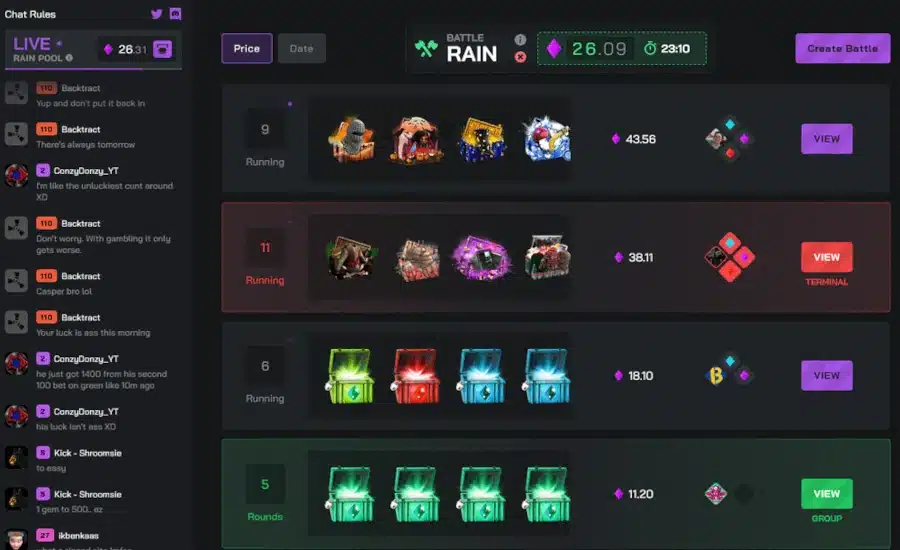
Participants usually pay for the same sequence of cases. Each case produces an item according to its item pool and odds. The platform then applies the battle format to decide how the items are distributed. In a conventional winner-takes-all battle, the highest combined item value wins the pot, but some rooms use different rules. Never assume the result is decided by a single expensive item without checking the specific mode.
For example, a room containing four cases priced at $2 each costs $8 per participant before any other fees. Opening the first case does not make the remaining rounds free. The displayed market value of a won item may differ from the operator’s deposit or withdrawal valuation, and available withdrawal stock can change. Treat the displayed item value as an operator quote rather than guaranteed cash proceeds.
Rust Case Battles Sites may allow a player to create a private room, join a public room, play against bots or use a team mode. Those features vary by operator. Check the actual battle lobby and the linked review before treating a feature as available. If the site shows a fairness verifier, test one completed round with its published inputs instead of accepting a “provably fair” badge alone.
How to compare Rust Case Battles Sites
Check the game
Open the current lobby, compare case prices and item odds, and read how ties, teams and bots are handled.
Check your skins
Confirm Rust item support, deposit valuation, trade holds, available stock and the minimum withdrawal.
Check the terms
Review bonus wagering, fees, account verification, age limits and regional restrictions before depositing.
When comparing Rust Case Battles Sites, use the RustStake review, Rustly review and BSite review to compare individual operators. These reviews describe broader platforms; always verify that the Rust case battle mode itself is live on the operator you choose. The Rust case opening guide explains single-player cases, while the Rust coinflip guide covers a different player-versus-player format.
Rust Case Battles Sites: fees and withdrawals
Skin deposits often rely on a Steam trade offer. Check the item names, recipient account and offer details inside Steam before confirming. Steam’s trade and market hold guide explains why some accepted trades are held before delivery. A platform cannot promise to bypass a hold imposed on your Steam account.
Calculate the effective cost from the deposited item valuation and the total battle price, then inspect any withdrawal threshold or conversion charge. A bonus may restrict eligible games, carry wagering requirements or expire. If you cannot find a clear rule for a fee, tie, voided room or withdrawal delay, ask the operator before playing. Do not deposit solely to meet a bonus threshold.
Rust Case Battles Sites vary in availability and permitted use depending on location and age. Set a fixed spending limit, do not chase losses, and use the independent resources at BeGambleAware if gambling is causing harm. Partner links may earn FlashyFlashy a commission; compare current terms independently.
Read the battle format before joining
- A standard winner-takes-all battle, a team battle and a shared payout mode can distribute identical case results differently. Before joining Rust Case Battles Sites, check who receives the opened items, how tied totals are resolved and whether a last-round modifier changes the winner. The entry price should include every selected case and any stated additional charge. A low headline price is not a meaningful comparison if the battle contains a different set of cases.
- Use the battle history to compare the settlement with the published format. Record each round’s item value and the final winner, especially when playing a team mode. For a different mechanic, Rust crash sites involve cashing out before a multiplier stops; Rust crash games do not use the same contest rules. A strategy for Rust crash therefore does not explain the odds of a case battle.
- Prefer clear case probabilities and settlement rules over animated wins. If the game does not explain how a result can be checked, ask for clarification before paying the entry fee.
Rust Case Battles FAQ
What are Rust Case Battles?
Players pay to open the same sequence of cases. Items are awarded according to the room’s published winner, team or alternative rule. Check the actual mode before joining.
Are Rust Case Battles the same as opening cases?
No. A single-player case opening awards the item rolled from that case. A battle adds other participants and a separate rule for distributing the combined items.
How much does a Rust case battle cost?
Add the listed price of every case in the room and check for any platform fee. A four-case room at $2 per case costs $8 per participant before other charges.
Can I deposit Rust skins on every case battles site?
No. Accepted Rust items, Steam trade requirements and regional access vary. Check the current deposit methods and item inventory at the operator.
Are the outcomes provably fair?
Some platforms publish a seed-based verifier. Look for the specific battle and case rules and reproduce a completed result where the operator offers that feature. A badge alone does not verify a round.
When can I withdraw an item?
It depends on the site’s inventory, minimums, account checks and Steam trade restrictions. Review the withdrawal page and current terms before depositing.
Do free cases guarantee a win?
No. Check eligibility, eligible cases, wagering rules, expiry and withdrawal conditions. A promotional case does not change the underlying probabilities.
What is the main risk in case battles?
Several paid cases can make one battle costly, while item outcomes remain uncertain. Set a limit and do not chase a previous loss with a larger room.